
What judgment does this research establish, and what evidence would invalidate it?
The Real Product in Back-Office Automation Is a Trustworthy Next Cycle
A back-office system can look successful while little has actually been settled. A task has moved to a completed column, an automated message says the work is done, and the person responsible assumes there is nothing left to check. Later, someone discovers that the system prepared a submission but never received confirmation, or that a record was matched using incomplete information. The original task now comes back with an explanation problem attached.
Accounting, payroll, and recurring administration make attractive software categories because the work returns whether the business wants it to or not. Yet unavoidable work does not make any particular software unavoidable. A specialist service, an experienced employee, or an existing combination of tools may already handle it adequately. The commercial question is whether a product makes the next cycle more dependable at an acceptable total cost, including the cost of handling exceptions.
That is a different proposition from maximizing automation. It requires persistent records, intelligible handoffs, explicit authority, and a credible response when something goes wrong. This essay examines that product mechanism. It is not advice about an individual company's accounting treatment, payroll obligations, taxes, or legal compliance.
The calendar creates demand, not proof of retention
A recurring obligation gives software another opportunity to be useful. It does not prove that the customer will choose the same product when that opportunity arrives. A business may return only because records are difficult to export, because a service provider has no alternative, or because replacing the system would be disruptive during a busy period. Those are important commercial conditions, but they are not identical to continuing customer value.
The observation window should follow the work. A monthly process may function well with little daily engagement. Repeated logins might indicate uncertainty, missing information, or an unresolved exception rather than healthy adoption. Designing reminders and secondary features to increase visits can create activity without improving the underlying obligation. A quiet system is not necessarily an unused one.
A more informative question is whether the next relevant cycle finishes with known status, understandable exceptions, and an effective handoff. Initial setup can establish that people can enter data and navigate a workflow. It cannot establish that the system survives a change of staff, a late document, or an unresolved item carried from an earlier period. Those claims require observation across appropriate conditions, not merely a more enthusiastic onboarding survey.
Preparation, recommendation, and execution are different permissions
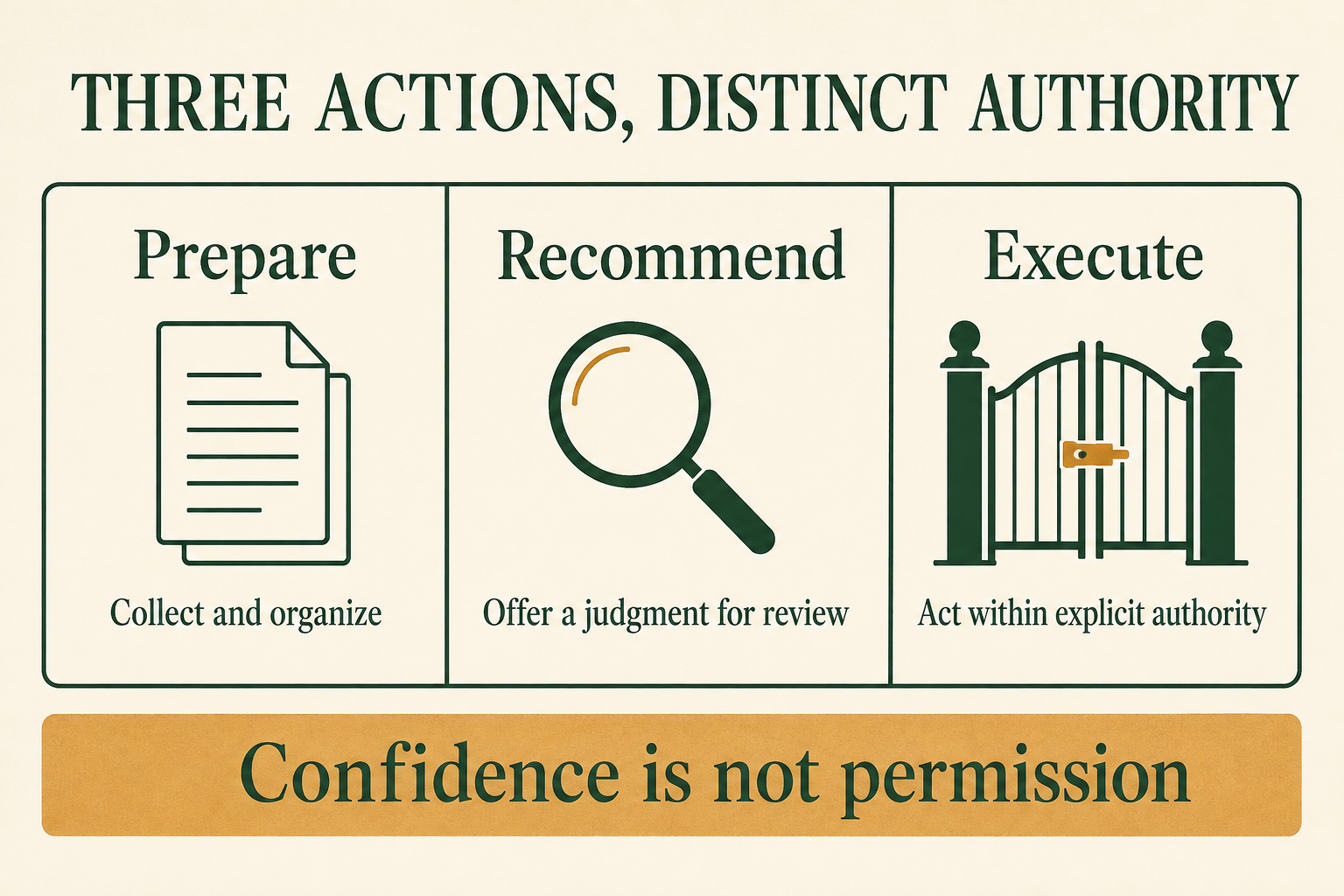
The word automation covers actions with very different consequences. Gathering information is not the same as changing an official record. Proposing a match is not the same as submitting an externally consequential instruction. A product demonstration that presents all of these as one smooth assistant journey makes it harder for a buyer to understand where responsibility has moved.
For each action, a buyer should be able to identify the required input, the permitted actor, the condition that allows progress, and the event that invalidates an earlier authorization. High confidence in a prediction does not create organizational authority. A system might be very confident that two transactions resemble one another without having permission to create a new handling rule or execute a downstream action.
The distinction appears in actual product constraints. Gusto's documentation for payroll on Autopilot specifies eligibility conditions and says the feature cannot be used when payroll approvals are enabled. The narrow lesson is not that approvals or automation are inherently preferable. It is that two separately advertised capabilities may not be available in the combination a customer needs. The customer's allocation of responsibility must be checked against the actual configuration. [Gusto's official Autopilot documentation](https://support.gusto.com/article/999755421000000/set-up-and-manage-payroll-on-autopilot-for-admins)
For a product team, this makes permission design part of the service rather than friction to eliminate. A confirmation that preserves a necessary decision is not equivalent to an unnecessary click. The useful task is to remove repetition around the decision while keeping its owner and evidence visible. That distinction becomes especially important when a workflow affects people outside the interface.
Exceptions are where trust becomes observable
Routine records make excellent demonstrations because their inputs already fit the expected pattern. Difficult records reveal what the system actually knows. A document may be incomplete, two sources may disagree, or a superficially duplicate item may represent a legitimate second event. If the interface displays only the clean main path, these cases return to messages, private notes, and the memory of an experienced employee.
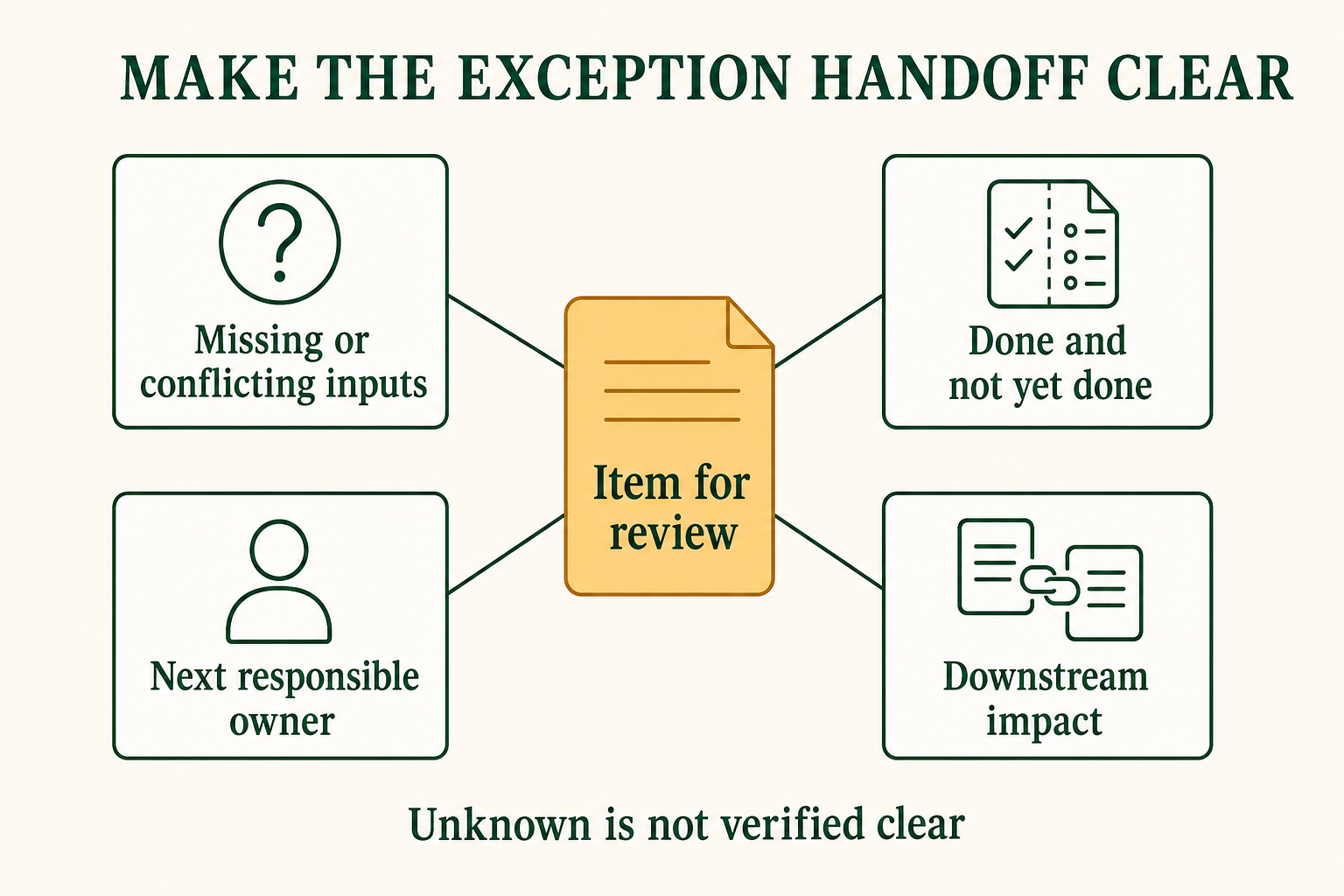
An exception queue needs more than a warning color. It should explain what is missing, what conflicts, what has already happened, what has not happened, and who is responsible for the next judgment. Unknown and verified clear must remain different states. The product does not reduce uncertainty by painting both green; it merely delays the moment when someone encounters the distinction.
Xero's current bank-reconciliation page describes automatic matches alongside suggestions requiring user judgment. It also describes controls for automation by bank account and the ability to inspect and correct automatically reconciled items. These are documented handoff capabilities, not independent evidence of perfect classification or a universal time saving. A useful evaluation asks whether a real user can understand and resolve an ambiguous item through that handoff. [Xero's official bank-reconciliation overview](https://www.xero.com/us/accounting-software/reconcile-bank-transactions/)
Exception handling also has an ownership problem. A queue can be visible to everyone and still belong to no one. If a question affects more than one role, the system should not assume that sending more notifications creates an accountable decision. A named owner, a clear request, and an understood escalation path are more useful than an increasing number of reminders.
A trustworthy state includes evidence of what it means
An assistant saying it has handled something compresses several possible states into a reassuring sentence. The materials may be ready. An action may be queued. An external system may have received a submission but not confirmed its result. Or the intended result may have been completed and acknowledged. Each state changes whether a user needs to act and what can safely happen next.
An evaluation model should separate readiness, authorization, submission, and confirmation. Readiness needs evidence of sufficient input. Waiting for approval should indicate that execution has not happened. Submission should identify the destination and time. Confirmation requires the relevant acknowledgment or independently checkable record. These are proposed assessment distinctions, not a claim that every named vendor uses these exact labels.
The same care must extend across periods. An unresolved item should not disappear when a new cycle opens. A revised rule should not silently replace the explanation of an earlier decision. Durable operational information is more than a growing pile of attachments: it preserves the relationship between a fact, the conditions under which it was interpreted, and any later correction.
That persistence is valuable during ordinary staff absence, not only a dramatic incident. Another authorized person should be able to tell whether work is waiting for information, waiting for a judgment, or waiting for external confirmation. When the only reliable answer remains in one person's head, the system has digitized documents without fully improving the handoff.
An audit log is an event record, not a correctness certificate
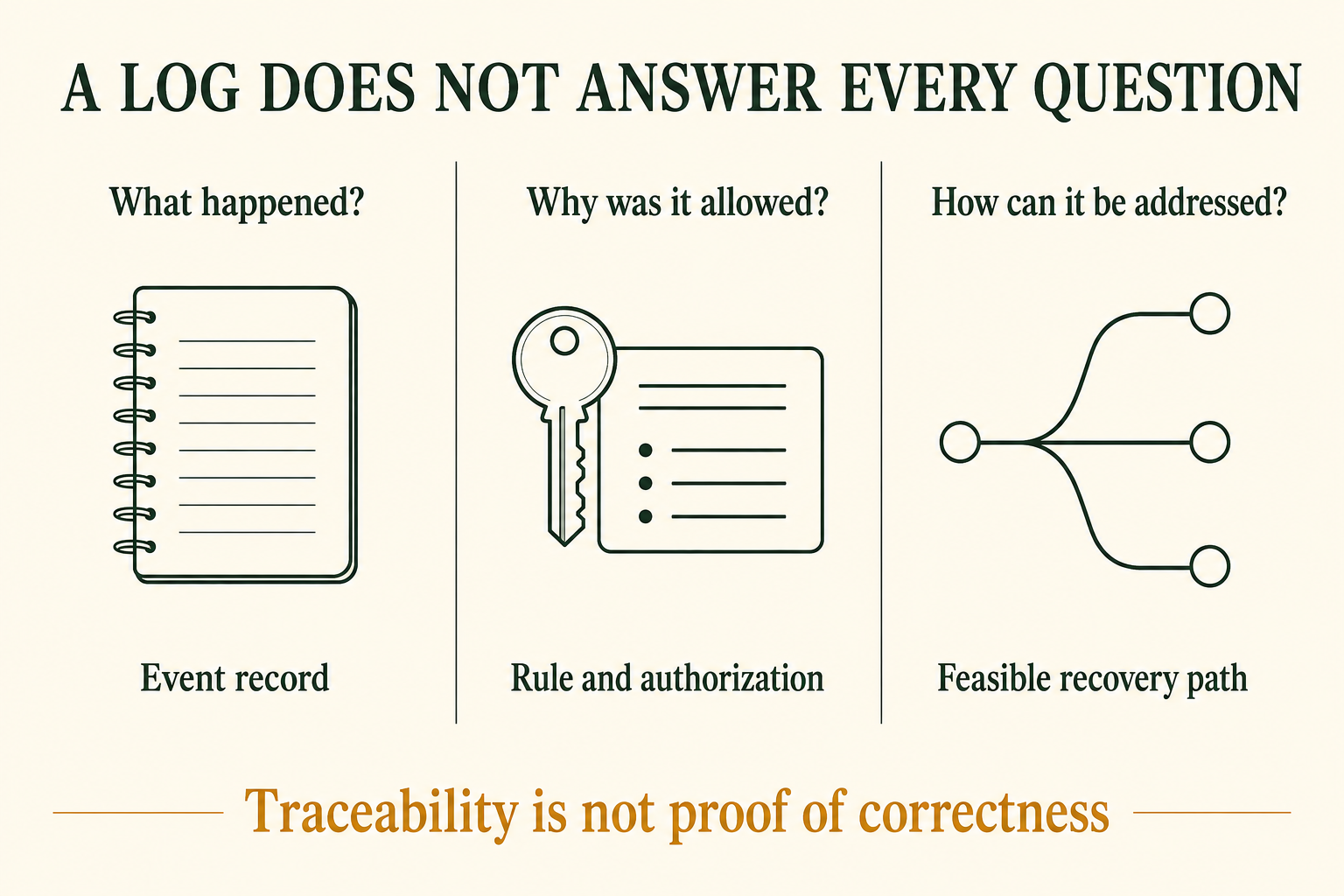
A log can accurately report that a change occurred without proving the change was appropriate. The action may have used a flawed assumption, lacked a necessary approval, or produced an unintended downstream result. Treating the presence of logging as a general guarantee removes precisely the questions a review should ask.
QuickBooks Online's official audit-log guidance describes records of user and system activity, including changes associated with other actions, connected applications, and recurring transactions. The documentation also describes access and record-availability limits. This supports the existence of change tracking. It does not establish perpetual completeness, guaranteed rollback, or that a company has passed an audit simply because the feature exists. [QuickBooks' official audit-log guidance](https://quickbooks.intuit.com/learn-support/en-us/help-article/audit-log/use-audit-log-quickbooks-online/L2WoVnW6I_US_en_US)
Three questions should therefore remain separate. What happened is an event question. Why it was allowed requires the relevant rule and authorization. How to address an error depends on the current state, available product controls, and the responsible professional's judgment. A record answering the first question cannot substitute for the other two.
Recovery is not always reversal. Some actions can be corrected within the product; others may require an additional entry, a documented follow-up, or action in an external system. Buyers should test the relevant recovery path without assuming a universal undo button. A clear statement of limits is more useful than a reassuring promise that ignores irreversible consequences.
Higher automation can hide a more expensive human remainder
Consider two hypothetical systems handling similar recurring work. One completes more routine items automatically but gives poor explanations for the remainder. The other asks for more review while making each ambiguous case easy to diagnose. An automation percentage favors the first. A complete account of investigation, support, repeated checks, and rework might not.
This is not a performance claim about any vendor. It explains why evaluation needs the whole workload. The difficult remainder may consume disproportionate attention, particularly when a person must reconstruct what the system already did. A small exception count is not necessarily a small exception cost. Nor does an exception resolved after prolonged manual work demonstrate that the automated path was reliable.
Costs can also move between roles. An owner might spend less time because an accountant spends more. Office staff may enter less information because employees face a more demanding intake form. A lower subscription bill may accompany more internal rule maintenance. A savings claim should identify who saved what, what work disappeared, and what work moved elsewhere.
Error categories matter for the same reason. An easily detected suggestion error and an unauthorized consequential change should not disappear into one average accuracy measure. A buyer need not invent a precise monetary value for every risk, but should identify tolerable corrections, conditions requiring a pause, and actions that are outside the pilot's authority altogether.
Design a pilot around a full cycle and a safe failure path
A useful pilot begins with a bounded recurring process and the people already responsible for it. They define the necessary inputs, the completion condition, and the authorization boundary. Existing practice can remain as a reference while the new system reads, organizes, and proposes. Any expansion into execution needs the appropriate authority and controls; a good demonstration is not permission to broaden the scope.
The pilot should include known edge conditions: a missing attachment, conflicting sources, an unavailable approver, or an item carried forward. The objective is to observe whether the system admits uncertainty early, reaches the right person, and preserves enough information for work to continue. Testing should not create real payroll, payment, or filing errors. Sensitive cases need suitable test conditions or a verification method chosen by the responsible professional.
At the end of the cycle, examine routine completion and exception handling separately. Check the total human intervention, the intelligibility of unresolved items, and whether records can be handed to another authorized person. If the product cannot explain what happened, expanding automatic execution is premature. If no meaningful exception occurred, exception handling remains untested rather than implicitly passed.
Repeated observations should also record changes in workload, staffing, and process. A calmer period can look like a product improvement. A temporarily difficult period can obscure one. A bounded pilot rarely establishes a universal causal claim, but it can provide a disciplined basis for a local decision: continue, narrow the scope, keep more review, or retain the existing approach.
Changed conditions can invalidate an earlier conclusion
A successful cycle establishes evidence for the conditions actually observed. A changed data connection, a revised matching rule, a departing employee, or a newly connected application can alter those conditions. Continued execution does not prove that the previously checked path is still the one being used. A system should make consequential changes visible enough for the responsible person to decide what needs another look.
This does not require a complete review after every cosmetic edit. The scope of checking can follow the scope of impact. A presentation change may need a readability check. A new interpretation rule needs relevant examples. A configuration changing external actions or authority needs the appropriate owner to confirm the boundary. The essential point is to explain why the chosen check is sufficient rather than relying on the fact that the old setup worked.
Support and exit arrangements belong in the same discussion. A product page cannot establish that a particular exception, response time, professional responsibility, or data-export requirement is covered by the customer's agreement. Buyers should identify the applicable commitments before relying on them. These are questions to resolve with the provider and responsible advisers, not guarantees inferred from a familiar brand.
The renewal case is transferable confidence
The strongest promise in this category is not that administration vanishes. It is that an important obligation depends less on one person remembering the history and being available at the right moment. The owner wants to know that nothing consequential has fallen between steps. The operator wants a manageable set of decisions. The specialist wants understandable records and sources. A useful system can support all three without erasing their distinct responsibilities.
There are sensible reasons not to buy. A low-volume business with stable procedures and a reliable professional service may gain little from a more elaborate platform. Another business may have enough volume but lack coherent source records or a responsible process owner. Automating that situation can spread an old problem faster. Improving the underlying process or preserving manual control may be the better immediate decision.
Renewal should therefore be explained by whether the next cycle remains easier to manage, not merely by how difficult it would be to leave. Dependence on understandable records is different from dependence on records nobody can export or interpret. The former can represent accumulated value; the latter can represent a trapped customer.
A dependable back-office product quietly absorbs the routine, exposes the exceptional, and carries authority and evidence forward. That is a more demanding product than a fast assistant. It is also a more credible reason to pay again when the next unavoidable cycle arrives.
Sources and limits
Official product documentation was checked on September 7, 2026 for the narrow capabilities and restrictions linked above. Vendor documentation is not independent evidence of customer outcomes. No current revenue, customer count, retention rate, error rate, or claimed savings percentage is used as proof. The illustrative scenarios and diagrams are evaluation models, not reports of pilots conducted for this article.
Product eligibility, contracts, record retention, accounting treatment, payroll administration, and compliance requirements depend on the actual organization and jurisdiction. Appropriate professional advice and current product documentation are necessary for those decisions. Automatic execution, human approval, and audit logging should not individually be represented as evidence that every applicable obligation has been satisfied.
Choose one bounded natural cycle, distinguish preparation from authority, execution and confirmation, and safely test the exception handoff while preserving untested conclusions.
Official documentation establishes narrow capabilities and constraints, not error rates, retention or savings. This is not payroll, tax, accounting-treatment or legal advice, and no live business pilot was conducted.