What judgment does this research establish, and what evidence would invalidate it?
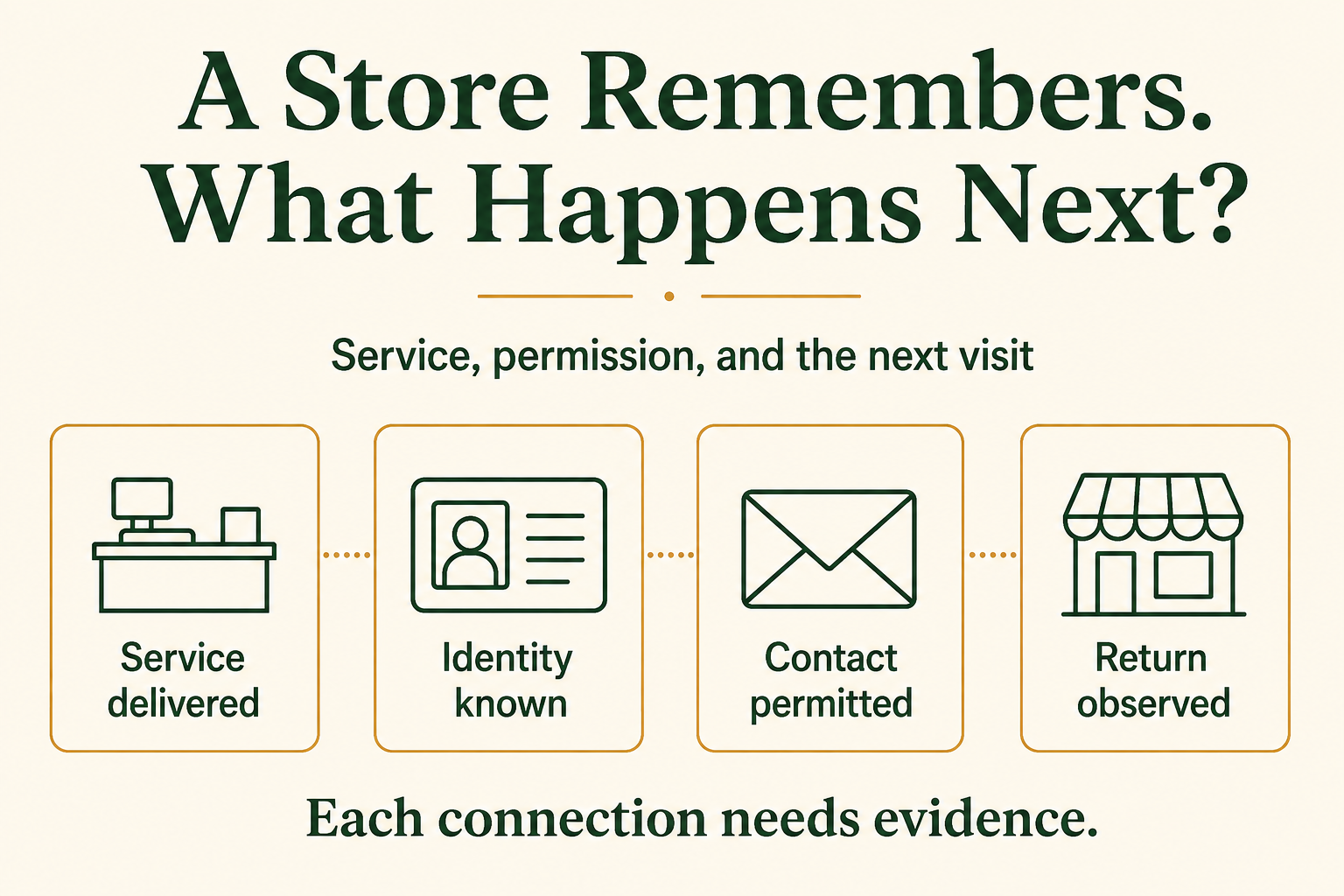
A Store Remembers. What Happens Next?
A store can know a customer's name without having permission to send a promotion. It can enroll someone in a loyalty program without giving them a reason to return. It can process a payment while a bag waits at the wrong collection point. These are not marginal exceptions to an otherwise complete operating loop. They are different promises, with different evidence of completion.
The interesting business question is therefore not whether a point-of-sale platform can connect transactions, staff, and customer records. Many product demonstrations can show connections. The harder question is what those connections enable people to do when a store is busy, a colleague has changed shifts, or a customer comes back with an unresolved request. Reliable service and a continuing relationship may reinforce each other, but neither can be inferred from a list of enabled features.
This article develops a mechanism to test: a local-store system becomes valuable when it helps one person continue a promise made by another. Whether it also earns the next visit requires a separate investigation. Operational memory is a capability. Customer preference remains a choice.
Start with a trading shift, not a feature inventory
Consider a hypothetical lunch counter. The cashier takes a changed order, the preparation team handles dine-in and takeaway requests, and a new employee starts at the collection point. A customer asks whether the missing item is still being prepared. This is an analytical scenario, not a reported customer result. Its purpose is to expose the work hidden behind a tidy transaction history.
Different people need different things from the same system. The owner wants a dependable operation and fewer unresolved questions after closing. Staff need to know which task is theirs and which instruction is current. The customer wants the right order and a credible answer when something is late. A strong management dashboard does not establish that the service team can meet those needs. The software may help one role while leaving another dependent on shouted instructions.
A full shift is consequently a more informative early unit of observation than a login. It includes changed orders, unavailable items, cancellations, remakes, and handovers between employees. It also exposes invisible rescue work. An experienced colleague may catch a routing error before a customer notices. That protects the customer, but the rescue should not disappear into a claim that the system worked without assistance. The next shift may lack the same person.
Nor is a busy period a self-explanatory benchmark. More complicated orders, different staffing, and unusual demand can change the number of exceptions. A quiet shift can look efficient because little coordination was required. Keep that context with any measurement and observe what happened at the difficult handoffs. The proposition worth testing is that responsibilities and current status become easier to understand under pressure. It is not that every available module was activated.
An order passes through different hands
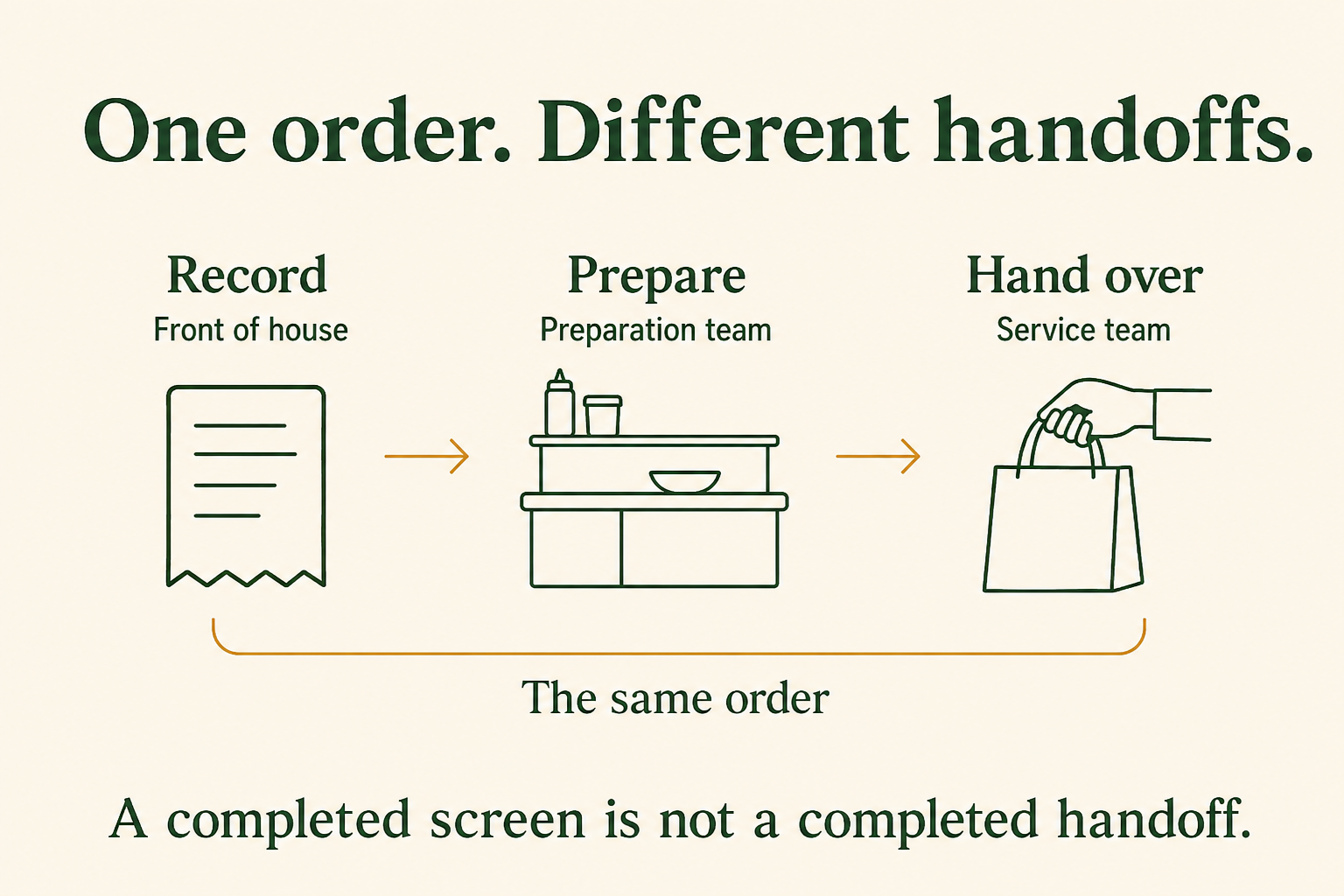
Recording an order, preparing its contents, and physically handing it to the customer are distinct events. They may happen seconds apart, but they do not necessarily involve the same employee or evidence. A single completed status can conceal where a customer waited and which colleague had to ask for clarification. The interface needs to express what was completed, not merely that someone touched a completion control.
Toast's kitchen-display documentation offers a narrow product example. It distinguishes preparation stations from expediter stations connecting front and back of house. In one described configuration, preparation completion, physical arrival at the expediter station, and subsequent fulfillment marking with configured notification are separate parts of the workflow. This establishes an ability to represent different handoff positions. It does not establish fewer errors or faster service in a particular restaurant. [Toast kitchen display system overview](https://dev.toasttab.com/doc/platformguide/platformKDSOverview.html)
The research implication is to follow the same order in both the software and the physical environment. A prepared status does not prove that a takeaway bag was collected. A collected bag does not prove it contains the corrected order. Ask who notices a discrepancy, who may correct it, and how the correction reaches the next person. A control in an interface makes an action expressible. Staff practice and actual use determine whether its state can be trusted.
Integration can make this easier, but it can also erase useful distinctions. Connecting another ordering channel may create work if its service requirements are forced into an unsuitable status model. Staff may then build a paper workaround around a nominally unified system. A simpler tool may be adequate for a store with a limited, well-understood workflow. The relevant boundary is handoff complexity, not the number of modules on a product page.
This is also where the store and its software supplier can disagree about success. The supplier may observe an accepted order and an active device. The team may still be coordinating delivery through memory. To establish operational value, the evidence must reach the moment when a person uses the shared information to complete the next responsibility. Without that observation, deeper workflow adoption remains a hypothesis.
Useful memory must tolerate uncertainty
After a transaction, the system can retain information about items, timing, location, service events, and an associated customer. The record matters when another task actually uses it. A returning customer may ask about an unresolved order. A new employee may need to know which remedy was promised. In these cases, continuity means reducing unnecessary reconstruction while preserving the context required to act correctly.
More information is not automatically better memory. A shared phone number can represent a household. Similar names can refer to different people. One person can appear through several payment or contact methods. Incorrectly merging records may produce a cleaner dashboard while attaching the wrong history to a customer. Incorrectly splitting them may hide a real return visit. Any account of repeat behavior should explain how identities were linked and what remained unidentified.
The customer, payer, recipient, and collector can also be different people. Group purchases, gifts, and collection on someone else's behalf make that distinction visible. A study need not solve every identity problem to make progress. It does need to avoid turning one useful identifier into a complete theory of the relationship. A phone number that links participation in a particular program does not necessarily identify every person served by the transaction.
Records age as well. A previous preference may no longer apply; a past detail may need correction. Useful continuity therefore includes a way for staff to acknowledge uncertainty and for customers to express change. The commercial hypothesis is that relevant, accurate context supports better service. Collecting more fields, creating more profiles, or making historical labels harder to change does not by itself strengthen that hypothesis.
Identity, permission, membership, and return are separate states
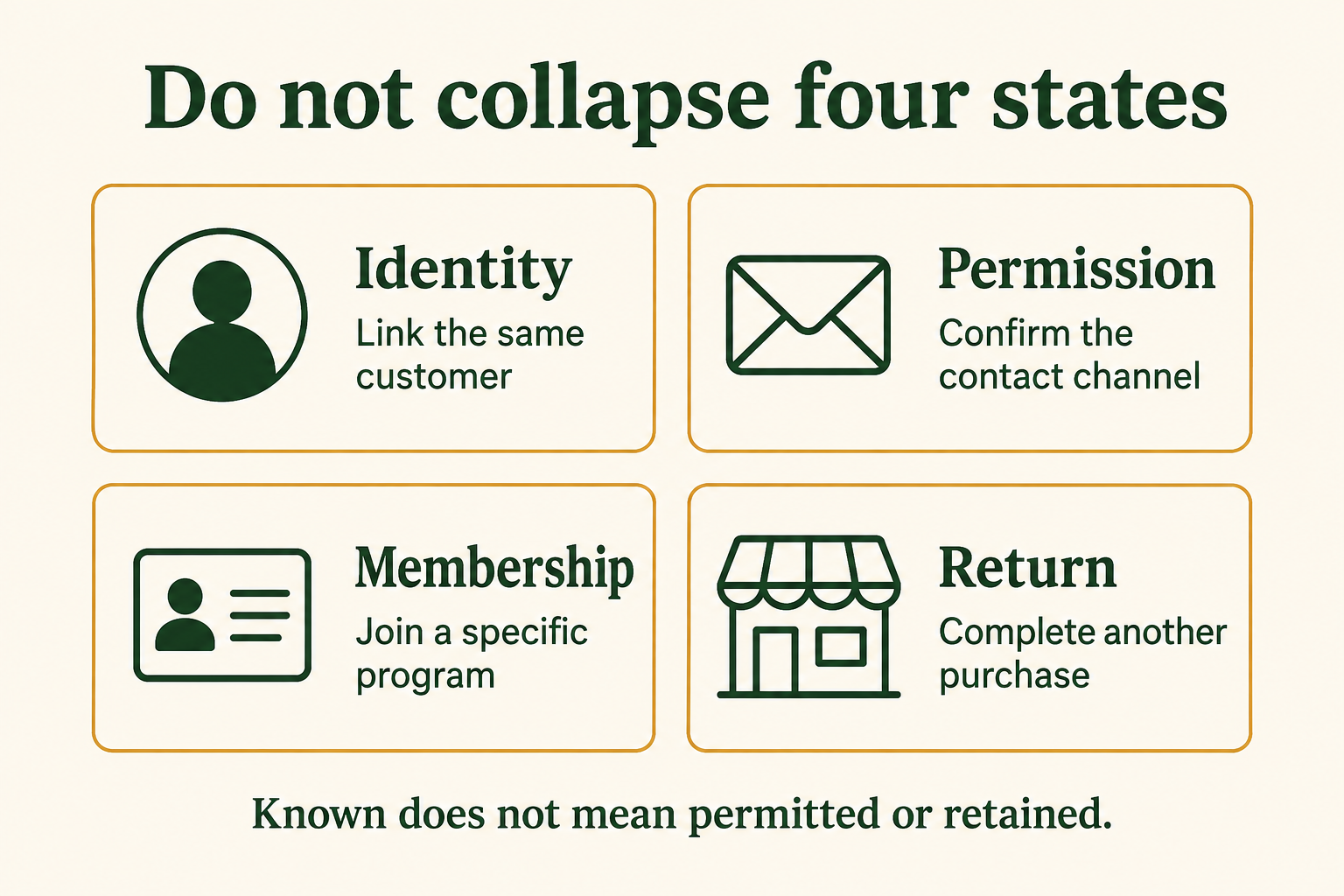
Four states deserve separate evidence. Identity concerns whether transactions can be associated with the same customer. Permission concerns whether a particular contact channel and purpose are permitted in the current circumstances. Membership concerns participation in a defined program. Return concerns another completed purchase or service occasion. They may be related, but no one state establishes the other three.
Square's US help material makes a concrete distinction between customer profiles and subscribed marketing contacts. It describes profiles that can be formed after transactions and explains that collecting an email through a receipt, invoice, appointment, or loyalty interaction does not automatically make it eligible for Square Marketing email; appropriate consent collection and recording are required. This is a product-specific distinction, not a statement of the law in every jurisdiction. [Square customer groups and filters](https://squareup.com/help/us/en/article/6245-manage-customer-groups-and-filters)
A separate Square help page describes a relevant point-of-sale loyalty flow in which customers enroll or sign in with a phone number. Using the same number connects points across payment methods; using different numbers creates different profiles. That establishes a particular association mechanism. It does not establish that enrollment generated another visit or that the resulting record gives permission for every kind of contact. [Square loyalty enrollment at the point of sale](https://squareup.com/help/us/en/article/6469-enroll-to-square-loyalty-using-square-point-of-sale)
For a researcher, these distinctions change the questions asked of a dashboard. An unknown permission state should remain unknown, even if a transaction is identifiable. A customer who returns without joining the program is still a returning customer. Someone who joins but has no new need has not necessarily rejected the store. Combining these states into a single customer-asset total makes the number larger while making the explanation weaker.
The distinction also protects the service experience. Declining a marketing relationship should not be interpreted as failure to complete the purchase. Nor should the research assume that a longer customer record is inherently preferable to an appropriately limited one. Each proposed use of information needs a relevant purpose and the applicable conditions for that use. The article's point is analytical: technical recognition, contact eligibility, program participation, and observed behavior are different facts.
The next visit has a reason and a clock
Coffee, haircuts, celebration cakes, and travel souvenirs do not generate the same rhythm of demand. A short observation window can reward a naturally frequent category and misclassify an infrequent one. Even within a category, moving home, changing workplaces, seasonality, budget, and satisfaction with the underlying service can affect the next purchase. Better records make some behavior more visible; they do not remove these competing explanations.
Start by asking when the customer would plausibly need the service again. Treat the answer as a hypothesis about an observation window, not a compulsory reminder schedule. When that need appears, can a previous order or service record reduce unnecessary explanation? Does the customer choose to return? If no new need exists, an opened message or clicked offer does not establish an improved relationship. Contact activity cannot define its own success.
Observed repeat and identified repeat must also remain separate. A change in how the store asks for information may make more repeat customers recognizable without changing the total number of return visits. Conversely, a customer can continue visiting while choosing not to supply an identifier. Keep anonymous transactions and changes in identification practice visible. Otherwise, a measurement improvement can be mistaken for a behavioral effect.
Location introduces another boundary. An office district and a tourist area may respond to different timing and needs. Shared membership across a chain does not establish consistent service at every location. Cross-store use may provide convenience, or it may simply move an existing purchase. A claim about a broader local network would require additional evidence that the available stores create useful new choices, in places where the relevant density actually exists. Enabling a program in one store does not establish that network effect.
A redeemed offer is not evidence of an additional visit
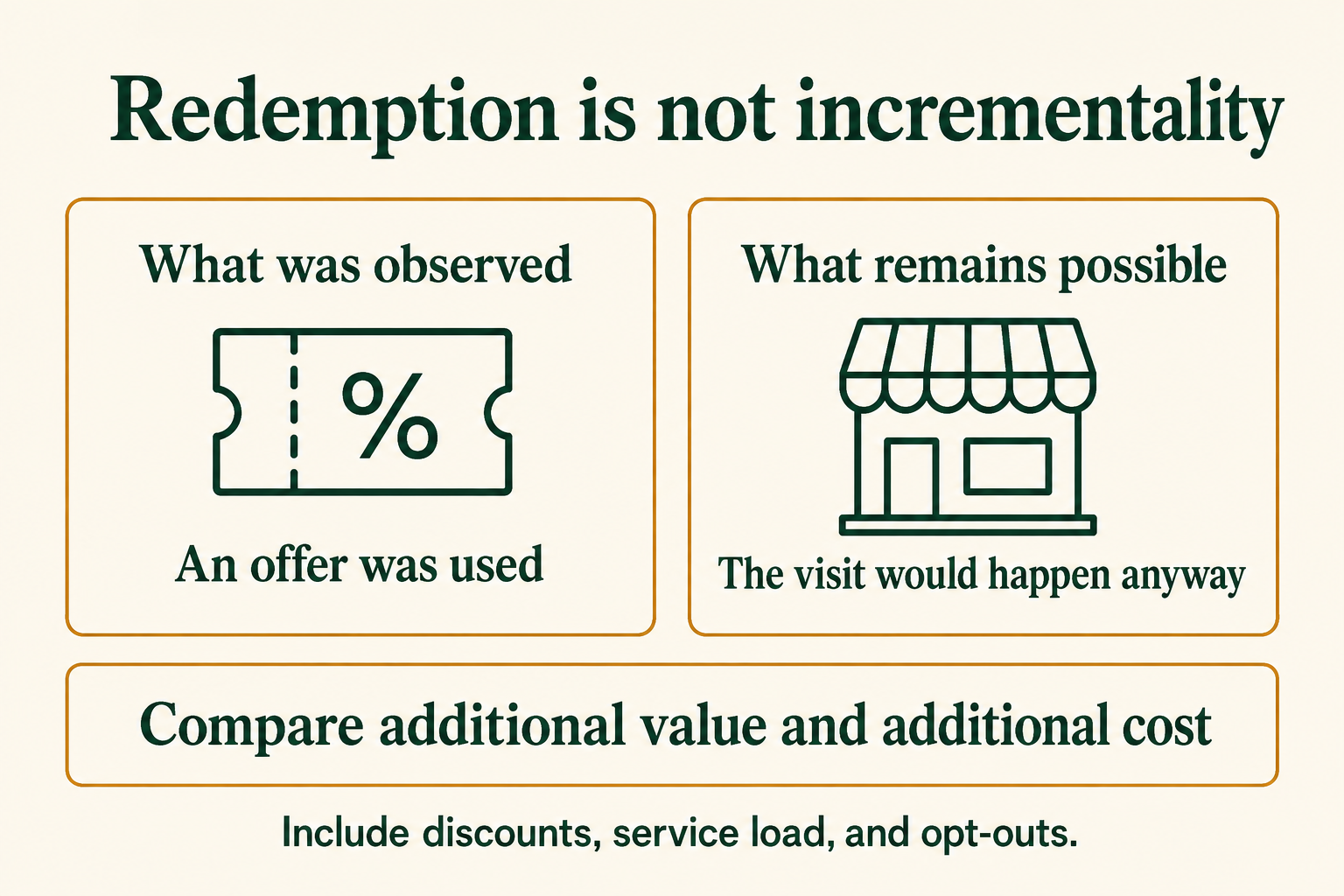
Redemption is a clear event: an offer was used. Incrementality asks a different question: what would have happened without that offer? Regular customers may be especially likely to join a program, notice a reward, and use it. Higher spending among members or more frequent visits among redeemers can therefore contain a large component of existing preference. The difference between groups is not automatically the effect of the feature.
To investigate additional value, define eligible customers, the natural observation period, and a defensible comparison before examining the result. Where feasible and consistent with existing customer commitments, a new activity can be compared with no exposure to that new activity. An experiment should not withdraw benefits customers have already earned. If a credible comparison is not possible, a smaller observational study can still produce useful clues, provided those clues are not promoted into a causal estimate.
Counting visits is only part of the result. A discount can subsidize an already-planned purchase or pull a later purchase forward, leaving less demand in the following period. Additional orders at a busy time can increase waiting, remakes, and staffing pressure. The store needs to consider additional contribution, incentive cost, service load, and unwanted-contact signals, including opt-outs. Continue observing beyond the immediate offer window where timing displacement is plausible. No universal numerical threshold settles these tradeoffs for every store.
These cautions do not imply that rewards lack value. A well-matched program might make benefits easier to understand, reduce the work of choosing again, or support continuity in service. But if an activity merely shifts regular customers onto a cheaper route to the same purchase, the owner needs to know. A system that can reveal no incremental benefit may be more useful for decisions than one that reports only redemptions.
The supplier's own value proposition should be examined at this level too. Continued payment for a marketing capability needs a reason that the merchant can recognize alongside maintenance and operating costs. A busy campaign panel is not that reason. Nor does a credible finding in one store establish an effect in every category, location, or customer group. The mechanism, population, and conditions need to travel together.
Earn the connection before expanding the promise
A practical investigation can begin with one store type, one order type, and one trading shift. Map who records the request, who prepares it, who hands it over, and who handles exceptions. Compare the shared record with the actual order, including the human rescues that prevent a failure from reaching the customer. Then observe another shift or operating cycle to see whether continuity depended on one experienced person remaining nearby.
Only after that should the investigation ask which customer state is worth carrying forward. Establish how records are associated, where uncertainty remains, and which contact permissions apply. Confirm that members and nonmembers can both complete the underlying service. For a group with a plausible next need, observe return over an appropriate interval. If the business claim concerns a new offer or contact activity, give it a separate comparison, cost assessment, and set of unwanted effects to monitor.
This sequence is not a demand that every store suspend marketing. It is a demand that each claim carry its own evidence. If the immediate failure is a handoff, another membership tier may be irrelevant. If service is reliable but the category lacks a near-term repeat need, more reminders may also be irrelevant. If customers return but identities are linked poorly, measurement should be corrected before a growth conclusion is drawn.
The most useful outcome of the research is consequently a precise account of the connection that has not yet been earned. A store operating system may help the next employee continue the previous employee's promise. It may also help a customer choose the store again when a real need arises and the relationship permits it. Those are related possibilities, not interchangeable achievements. Keeping them separate is how an attractive operating-loop story becomes a testable business proposition.
Sources and limits
This article extracts workflow questions from the underlying store-system research without adopting its company rankings, revenue or scale figures, internal operating plans, or feature-retention conclusions. First-party documentation is used only for narrow product facts: Toast's differentiated kitchen handoffs, Square's distinction between profiles and marketing subscribers, and the phone-based association in a relevant loyalty flow. None of those documents establishes fewer errors, additional visits, improved merchant profit, or product-market fit.
The arguments about shifts, reusable state, natural demand, and additional value are an analytical framework requiring real operational evidence. The hypothetical lunch counter is not a case study. US product documentation is not automatically applicable in other markets and does not replace checks of local privacy, permission, industry, or operating conditions. This is not a platform ranking, purchasing recommendation, or legal opinion. The next step is to trace one specific service promise and its next plausible demand occasion, not to assume that an entire loyalty-growth system has already been justified.
Follow one order across a full shift, compare the record with the physical handoffs, then investigate customer states and the next plausible demand occasion separately.
This is an analytical framework, not a causal result. First-party documentation supports specific workflow and association mechanisms, not fewer errors, additional visits, or improved profit. Local conditions require separate checks.