
What judgment does this research establish, and what evidence would invalidate it?
They Love the Product. Why Won't They Buy?
The objection may arrive before the price does
A promising demo ends with enthusiasm. The prospective user asks to stay in touch and offers ideas for the next release. Then the conversation goes quiet when payment comes up. For a founder, the obvious response is to make the offer cheaper: add a free tier, extend the trial, or introduce a discount. Sometimes that is the right move. But it does little for someone who cannot authorize spending, has no immediate job to do, or cannot tell what a successful delivery would look like.
The more useful question is not simply how much the customer will pay. It is what has to become true before a purchase makes sense. Price sits inside a decision involving responsibility, urgency, alternatives, trust, and practical buying constraints. An attractive feature can satisfy none of those conditions. A modest service with a clear scope can satisfy several.
This essay develops a research approach from our existing notes on payment decisions and pricing. It is a framework to test, not a conversion formula supported by a customer dataset. The consulting and research examples below are hypothetical. They are not client stories, revenue claims, or reports of measured outcomes. We also set aside the source notes' country-level payment assumptions and numerical research targets: those require their own evidence before they can support a market conclusion.
Start with a job, not a willingness-to-pay question
Ask someone whether they would pay for a useful tool and you invite an answer about an imagined future. Ask about the last time they did the work and you can begin reconstructing something observable. What started the task? What materials were available? What did the person actually do? Where did work stall, and who dealt with the consequences?
A redacted work sample can make that conversation much more concrete. Follow the task from input to handoff, including corrections and rework. Keep an actual loss separate from an anticipated risk or a minor irritation. All may matter, but adding them together does not produce a defensible estimate of economic value. An estimate of time spent is not automatically cash that a new product can save.
Look for the current alternative, even when the person says there is no competing product. A spreadsheet, an assistant, a contractor, an informal favor, and leaving the task undone are all alternatives. Choosing not to act may be reasonable when the problem is small or the remedy creates more risk. Your research needs to explain that choice before it treats the absence of software as evidence of an opportunity.
Follow the money through the people involved
Consider a small team evaluating a tool for organizing research material. An analyst would use it. A manager wants fewer corrections. Another colleague handles the contract, and a separate budget owner may approve spending. Interviewing only the analyst produces a feature wishlist. Interviewing only the budget owner produces cost constraints. Neither tells the whole story.
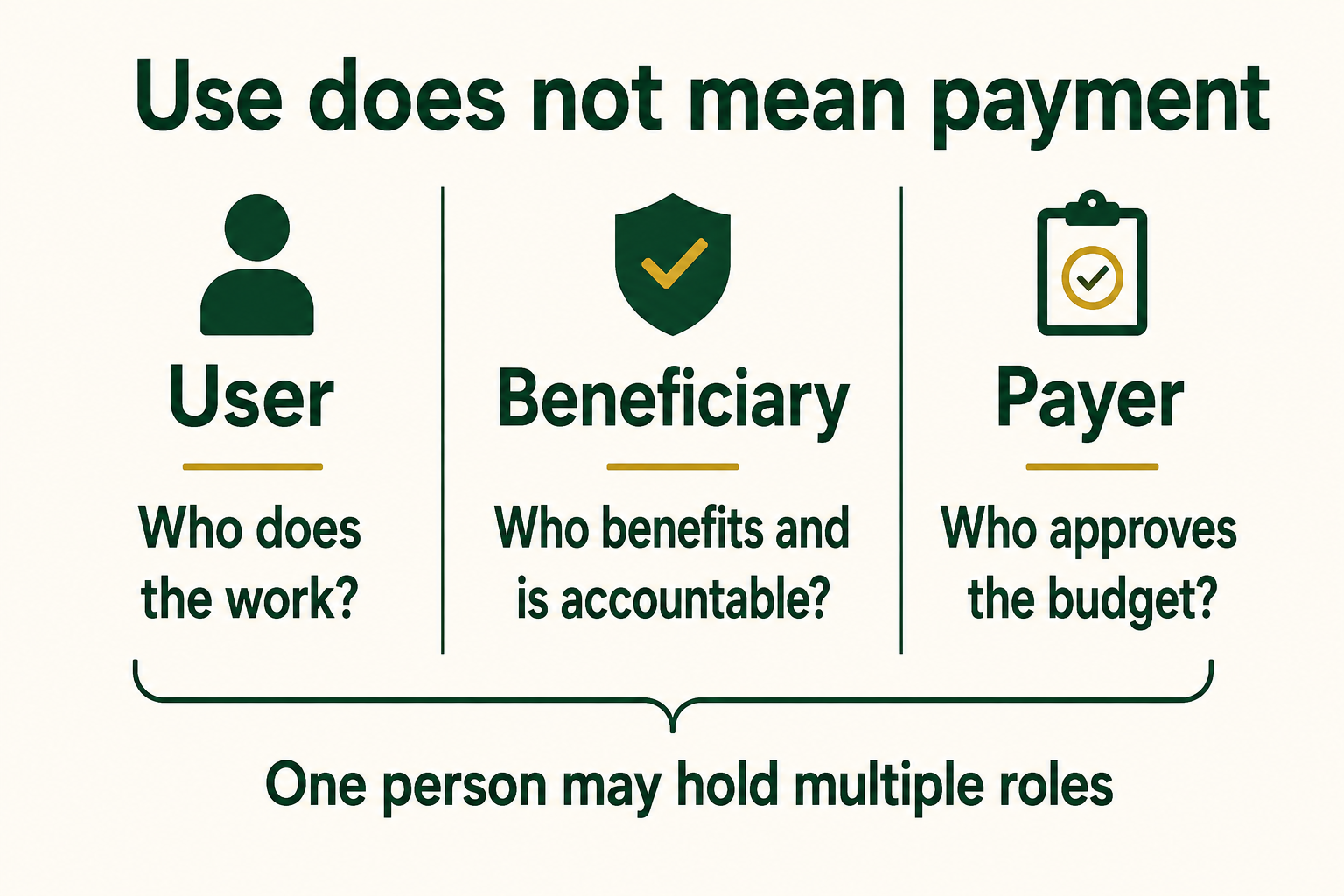
Map the user, beneficiary, evaluator, budget owner, and potential veto holder. These are roles, not necessarily separate people. Even an individual buyer can have conflicting priorities: the person who wants help studying may also be the person worried about another forgotten subscription. A good offer has to make sense to both concerns.
Make the map specific enough to check. Who receives the finished work? Who is accountable if it is wrong? Which budget paid for the previous solution? If the answers are unavailable, record the payer as unknown. Do not promote a friendly user into an economic buyer simply because your business model needs one.
Find the event that moves the job up the queue
A persistent problem is not necessarily an urgent purchase. There may be a deadline approaching, a change in workload, a broken process, or a new person taking responsibility. These are possible buying triggers to investigate, not reasons to manufacture urgency in a sales message.
Imagine an independent consultant who occasionally needs interview material organized. A one-off service may fit that pattern better than an annual commitment. Another consultant does similar work every week and may have a reason to keep a tool available. Their job titles match, but the rhythm of value does not. The example is a prompt for research, not evidence about consultants as a market segment.
Instead of asking whether someone might buy eventually, ask when the next real task will occur and what must happen before they can choose a solution for it. If neither the task nor the decision process can be identified, interest remains a weak signal. A courteous promise about the future should not enter a forecast as an imminent order.
Reduce the work required to judge your offer
An unclear promise makes the buyer do extra work. They have to imagine the deliverable, guess what remains their responsibility, and decide what happens if the result is unsuitable. Under those conditions, saying the price is too high can be easier than explaining the uncertainty.
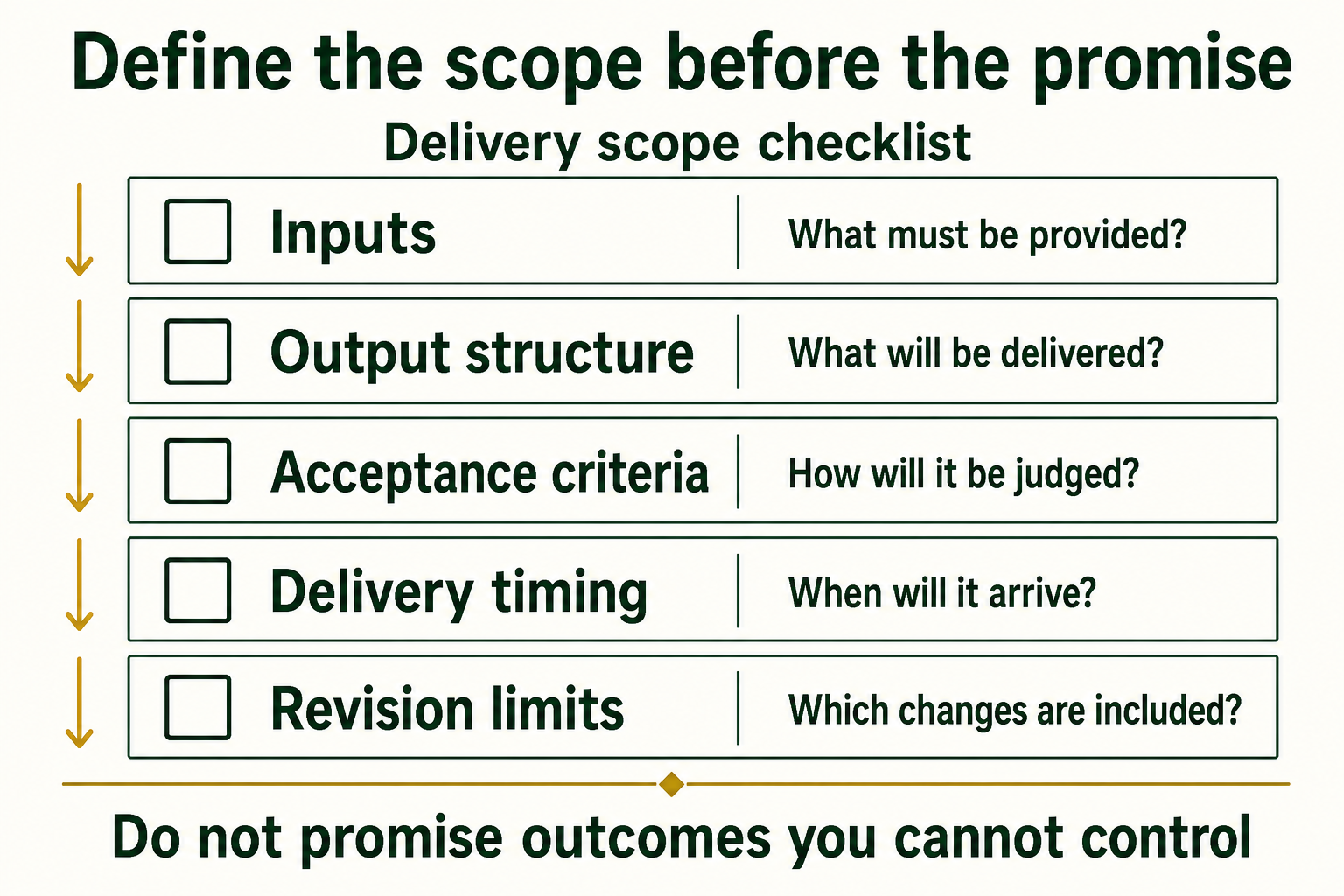
A scoped research-organizing service might specify the accepted input materials, the structure of the output, how sources can be traced, the delivery window, and the revision boundary. It should not imply that organizing information guarantees investment performance or replaces professional judgment. Easier review and fewer duplicated steps are plausible sources of value; their actual effect still has to be observed in use.
Build a representative deliverable before polishing the pricing page. Show the full structure, not only the most impressive excerpt. Can the prospective customer use it in the next step of their work? If that remains unclear, more features may not help. The problem may be the output format, reliability, or the effort of bringing the result into an existing process.
Charge in the same rhythm that value arrives
A one-time purchase fits a bounded, occasional job, but it requires the seller to earn the next purchase again. A subscription needs a credible reason to remain valuable in each billing period. Putting information behind a recurring charge does not establish that reason. Usage-based pricing can fit intermittent demand, provided the customer can understand the unit of consumption and anticipate the bill.
Milestone payments can suit work with meaningful handoffs: diagnose the problem, agree a plan, carry it out, and review the result. Each stage should deliver something useful and leave room to stop when new information changes the case. The point is to share uncertainty sensibly, not to disguise a large commitment as a series of difficult-to-exit smaller ones.
Outcome-based pricing deserves particular care. Before considering it, investigate whether the outcome is clearly defined, who controls the inputs, and how the contribution of the service could be distinguished from other influences. If customer execution or external conditions dominate the result, the pricing model may obscure accountability. An early offer should be explicit about what the provider can deliver and verify instead of guaranteeing a result outside its control.
Make an offer someone can actually refuse
A real quote concerns a real task. It names the price, scope, timing, required contribution from each side, and conditions for stopping. It gives the buyer something definite to accept, reject, or amend. Asking for an abstract price range does not create the same situation: the information available and the responsibility involved are different.
When an offer is declined, separate the possible causes. No budget is not the same as no budget authority. No task this month is not the same as no recurring need. Distrust of the output differs from the cost of switching away from a familiar process. And sometimes the offer really is not worth the asking price. Preserve the customer's words and supporting evidence instead of putting every refusal in a single expensive bucket.
Keep a version of each offer and note what changed. A lower price combined with more support cannot tell you which change influenced the decision. Early research does not need elaborate experimental machinery, but it does need a record that avoids confounding every adjustment. Otherwise the founder may end up validating an ability to make unlimited concessions rather than a repeatable business.
A payment opens another set of questions
Payment is stronger evidence than praise, but it can still reflect curiosity, a large discount, or support from someone who knows the founder. What happens afterward matters. Does the customer start using the service? Complete the intended task? Need extensive help? Request a refund? Return when a new need arises? A count of paying users cannot answer those questions on its own.
Record the full cost of delivery: preparation, communication, revisions, support, and rework. A service can appear profitable when the founder's time disappears from the calculation. Future automation may change the economics, but keep that possibility separate from today's operating costs. A hoped-for efficiency gain is not evidence that the current model is sustainable.
Interpret repeat behavior in the context of the job. A low-frequency service may not need monthly repeat purchases. The relevant observation is what customers do when the problem returns. For a frequently needed tool, payment followed by non-use calls for a different investigation into task strength and adoption friction. The measurement should follow the way value is created, not a standard retention chart chosen for convenience.
Keep a serious place for disconfirming evidence
If customers buy only at a steep discount, investigate whether they value the result or merely the bargain. If every engagement requires a different service, revisit the delivery boundary before claiming the work has become a product. If paying users fall back to their old method, look for the learning, verification, or coordination burden the new approach introduced.
Another warning sign needs a careful interpretation: a person describes an acute problem but cannot share even a redacted sample or arrange a real task. That might reflect access restrictions or privacy concerns, not an invented need. Reduce unnecessary data requests or seek another observable form of evidence. If there is still no way to inspect the work, leave the evidence incomplete rather than guessing.
A pause is not a permanent verdict on the idea. It should identify the missing condition: access to a budget owner, a credible deliverable, a narrower scope, or a genuine buying window. A precise uncertainty provides a better use for the next research effort than a vague conclusion that more marketing is needed.
Build a record that can change your mind
For each interview or offer, keep the task and its timing, the people using and paying, the current alternative, verified spending or loss, the offer version, the response, and subsequent use and delivery effort. Leave unknowns open and specify what would resolve them. Do not use founder intuition to complete missing fields.
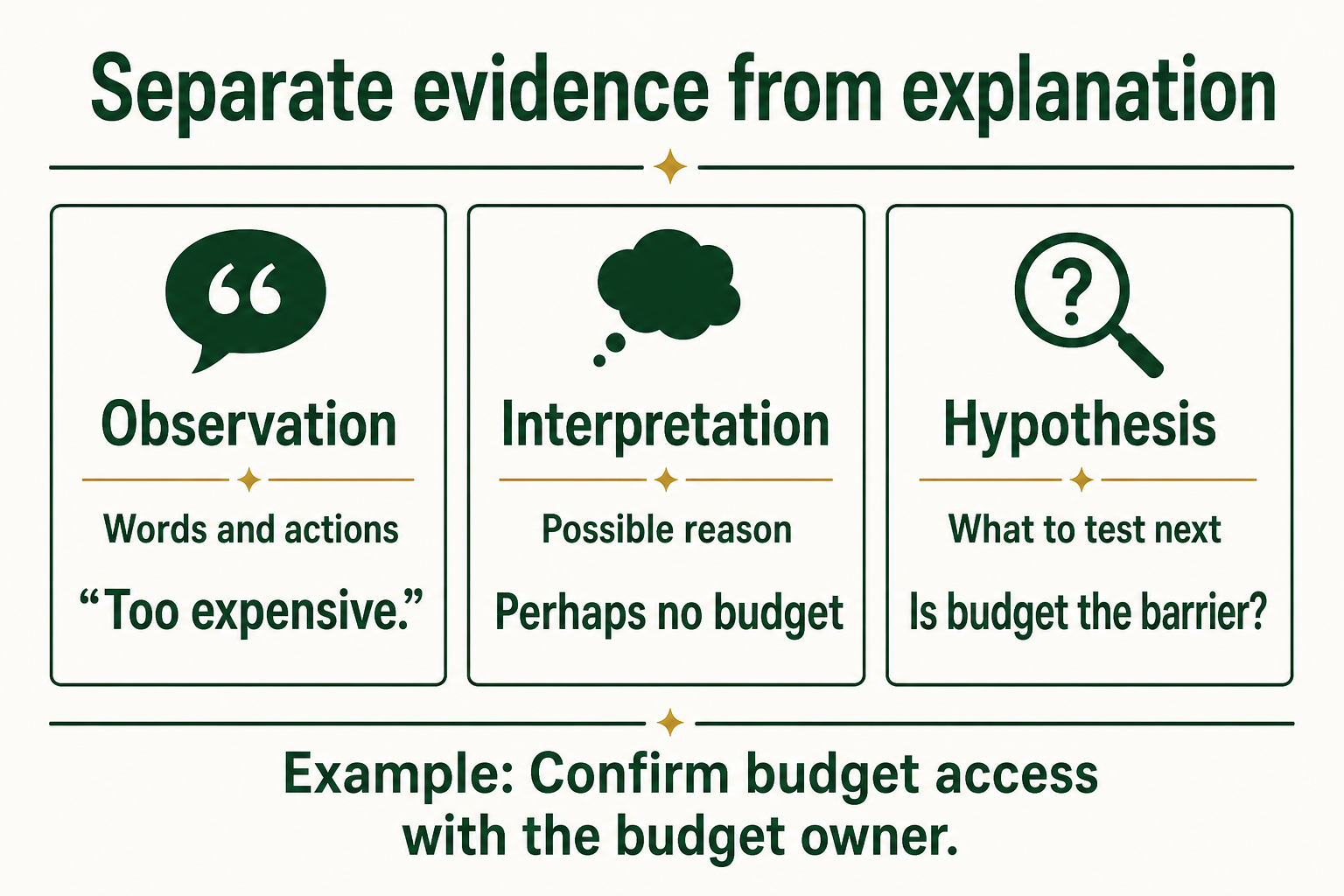
Distinguish what the person said, what you observed, your interpretation, and the next hypothesis. A customer saying the offer is too expensive is a recorded statement. Concluding that they have no budget is an interpretation until you investigate further. This separation makes the research more useful when you later reconsider the price, service design, or target customer.
Return to a recent offer that did not close. Who needed the result? Who was responsible for it? Who could pay? Why did the work need doing then, and how would the buyer know it had been done well? If those questions still have substantial gaps, lowering the price is only one possible response—and may not address the decision at all.
Source and limits
This essay adapts the research archive note on payment decisions and pricing, including its six-question framework, role distinctions, charging models, and possible counterevidence. The examples are editorial constructions, not observed customer engagements. No market conversion rates, population-level payment preferences, or revenue data are asserted. The framework is a starting point for investigation, not legal, tax, medical, or investment advice.
Revisit a real offer that did not close and identify the buying conditions you have not yet verified.
This is a research framework, not a validated conversion formula. All worked scenarios are hypothetical, and no customer outcomes or market-level payment preferences are asserted.