
What judgment does this research establish, and what evidence would invalidate it?
Why a Cheaper Software Suite Can Still Be the Wrong Purchase
A small company has two scarce resources when it buys software: money and the attention required to make the purchase work. A proposal can save subscription fees while consuming the owner's time, adding work for employees, and creating an internal configuration job that nobody expected. Another proposal may look expensive by the seat but fit the existing workflow with much less interpretation. The invoice alone cannot settle the comparison.
This is the central problem behind the promise of an operating system for small business. Connecting work across a company can be valuable. But putting many applications under one brand does not establish that people will share trustworthy information, stop duplicating work, or manage exceptions more effectively. Integration is a proposed mechanism, not a completed business outcome.
A useful buying framework must therefore compare complete ways of operating. These include a broad suite, an industry-specific product, a configurable platform, selected point tools, and the current process supported by reliable people. The question is not which option looks most modern. It is which arrangement resolves a real coordination problem within the company's budget, capabilities, and appetite for change.
A coordination event is more informative than a headcount threshold
There is no reason to assume that every company suddenly needs an integrated platform at the same size. A small team spread across locations and overlapping customer commitments may face difficult handoffs. A larger team with independent, stable work may coordinate adequately with simpler arrangements. Headcount describes the customer; it does not prove the structure of the customer's problem.
Start with a recent event. A customer changed a requirement, but the next person did not receive the update. An owner had to reconstruct the same status from several messages. A new employee could not continue without an experienced colleague interpreting the history. These events reveal where work depends on repeated explanation or on a person being available at the right moment.
Trace who noticed the issue, whom they contacted, what they waited for, and how the work resumed. This produces a more concrete basis for a budget than a general desire to centralize everything. The problem may justify a modest intervention, a change in responsibility, or a larger system. Its existence does not determine the product category in advance.
Demand becomes commercially meaningful when somebody owns the cost of that friction and can evaluate an alternative. A team expressing interest in a unified dashboard may not yet have that clarity. A small company repeatedly losing managerial attention at one consequential handoff may have a stronger buying reason, even if its software estate looks uncomplicated.
Buyer, operator, and maintainer face different bargains
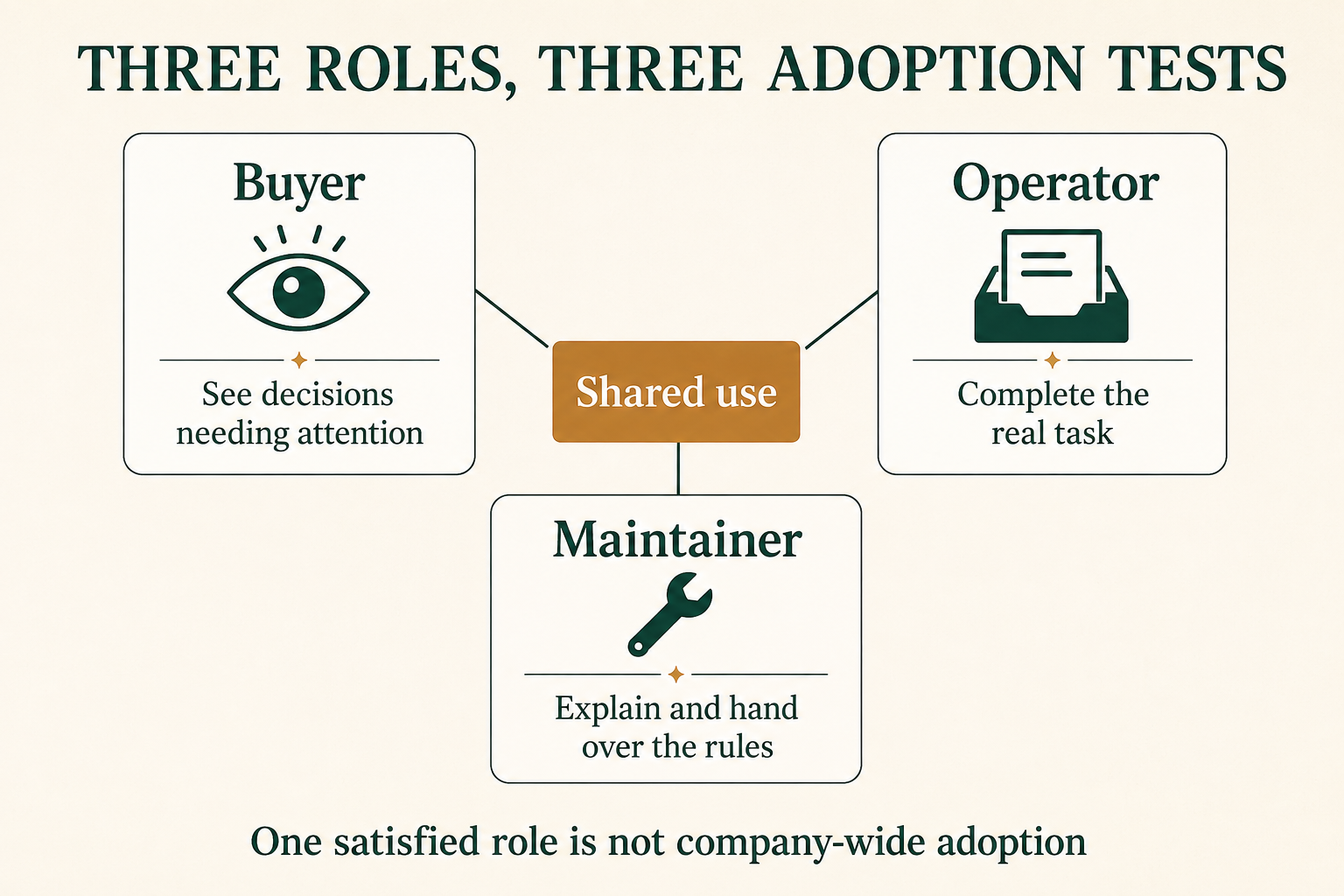
The buyer may want visibility and fewer interruptions. The operator wants to finish work without extra record keeping. The maintainer must understand fields, permissions, integrations, rules, and changes of staff. One person can occupy several roles, but the evaluation should still distinguish them. A consolidated management view may be funded by additional effort at the point where information enters the system.
This is why executive enthusiasm is incomplete adoption evidence. If useful records depend on employees repeatedly supplying information without receiving corresponding help, quality may depend on reminders. If one enthusiastic employee configures everything, the organization may replace an old dependence on personal memory with a new dependence on personal technical knowledge. The point of failure has moved rather than disappeared.
A trial should let each role complete its actual work. Can the buyer identify a decision requiring attention rather than merely admire totals? Can the operator act in the real setting without maintaining a second record? Can the maintainer explain a rule and hand it to another authorized person? These are related questions, not interchangeable measures of satisfaction.
The benefits need not be identical across roles. A small increase in one person's effort may enable a substantial improvement elsewhere. But the trade must be acknowledged, agreed, and budgeted. Otherwise the software can win the purchase meeting while losing the daily negotiation that keeps its records useful.
Products distribute workflow-design work differently
An industry product contains judgments about how a particular kind of business operates. Jobber's official workflow overview identifies requests, quotes, jobs, invoices, and payment as common building blocks, while explicitly noting that every project need not use every step. This establishes a documented business-oriented structure with some path variation. It does not establish customer growth or a standard time-saving effect. [Jobber's official workflow overview](https://help.getjobber.com/en/articles/jobber-workflow-overview/)
A predefined structure places some design work with the vendor. For a closely matching business, that may reduce the effort of defining states and handoffs from a blank page. For a business with materially different work, the same assumptions may require workarounds. The right test is not whether the standard demonstration is coherent, but whether the customer's meaningful variations remain coherent too.
A configurable platform places more design decisions with the customer. That flexibility can be useful when work crosses teams, projects differ, or the process is still evolving. Yet somebody must choose the structure, preserve consistent meanings, and update the configuration as circumstances change. Freedom from a preset workflow is not freedom from workflow-design costs.
Neither approach is categorically more sophisticated. The commercial distinction is where the costs of process design, exception interpretation, and change management sit. A buyer should ask which party is better equipped to carry each cost and whether the proposed arrangement leaves any important responsibility unowned.
The licensing denominator comes before the price comparison
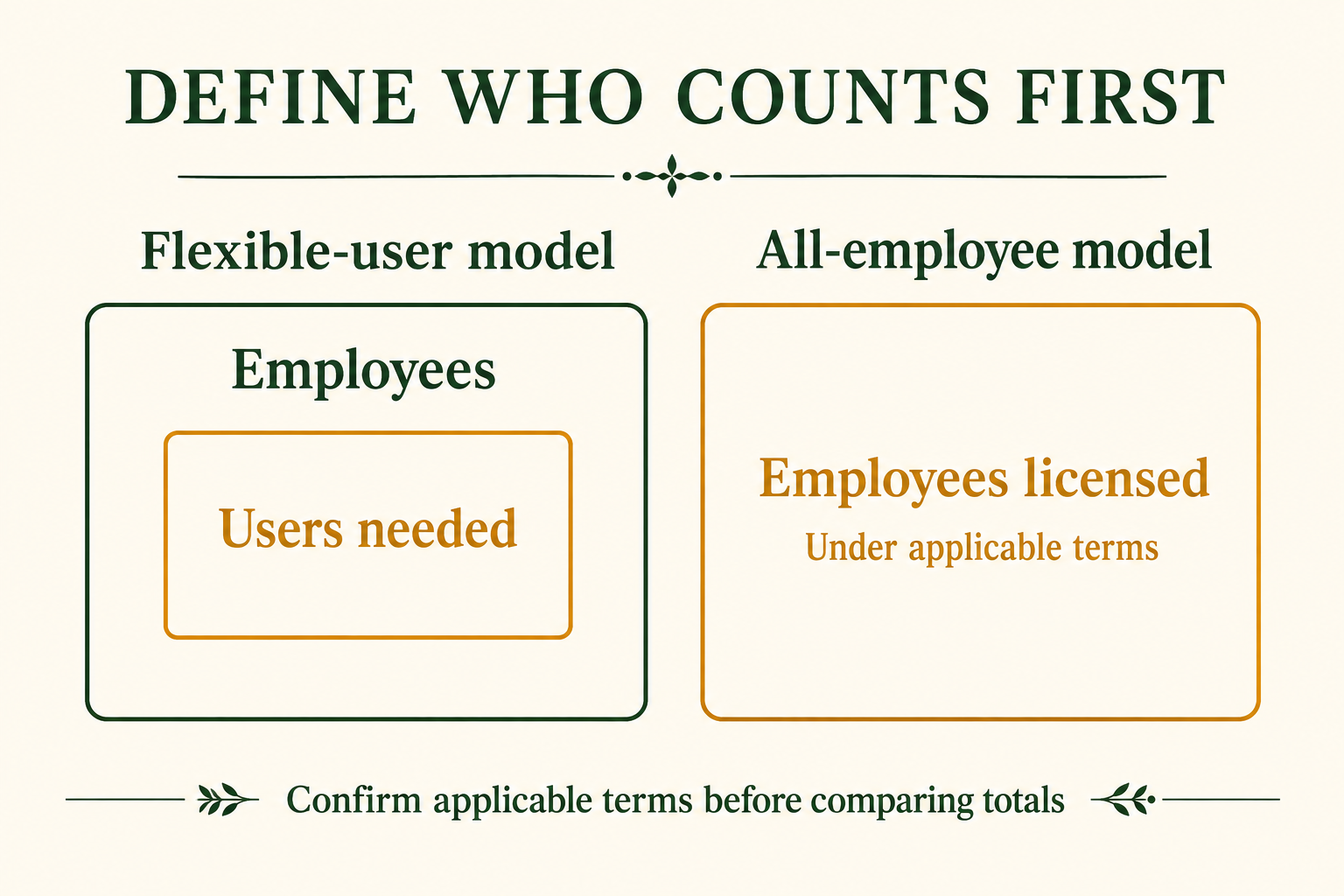
A per-person price looks simple until the meaning of person changes. It might refer to actual users of an application, everyone requiring an account, or the company's employees more broadly. Different licensing bases can produce different total costs for businesses with identical headcounts. They can also affect whether partial adoption remains a practical option.
Zoho One's official pricing FAQ distinguishes flexible-user licensing from an all-employee model. The former allows licensing the users needed; the latter requires licensing employees under that model, with particular circumstances directed to the provider for clarification. The relevant evidence here is the licensing basis, not a dynamic price copied from a promotional page. Buyers need to establish the applicable denominator before comparing totals. [Zoho One's official licensing FAQ](https://www.zoho.com/one/pricing/faq.html)
This matters across industries because access patterns vary. A business in which most people work continuously in digital tools is not the same purchasing case as one with many field roles and a small office team. Neither should infer its obligations from the other's estimate. Actual role requirements and the provider's applicable terms must meet in the same calculation.
The exercise is not an argument against broad licensing. A broad model may be entirely reasonable when useful adoption is broad as well. It is an argument against comparing headline prices with inconsistent populations. A seemingly precise spreadsheet remains misleading if each column is counting a different group of people.
Usage and maintenance create another cost dimension
Seats may not be the only factor that changes with use. Automated actions, connected services, storage, support, or optional modules may affect the eventual cost or capacity of a workflow. Buyers do not need to predict every future pricing change. They do need to identify the present boundaries and understand what happens to the work when those boundaries are reached.
monday.com's official guidance explains automation and integration action consumption, including workflows in which one trigger can involve multiple actions. Applicable allowances have their own rules. This narrow fact illustrates why a workflow's structure and run frequency can matter alongside account count. It does not show that the product is necessarily expensive or reveal any particular customer's actual bill. [monday.com's official actions-and-limits guidance](https://support.monday.com/hc/en-us/articles/360017556179-Automation-and-Integration-actions-and-limits)
Maintenance is a separate recurring commitment. Someone needs to notice when a rule no longer fits, check a connection after a field changes, manage access when people join or leave, and explain the setup when its original author is unavailable. These responsibilities need not require a full-time specialist, but they cannot safely belong to nobody.
Listing them helps both sides of the comparison. It prevents a flexible tool from appearing costless merely because configuration is done internally. It also prevents a suite from appearing maintenance-free merely because several modules share a vendor. The proper estimate follows the operating arrangement, not just the visible procurement line.
The incumbent may be a toolset plus a dependable person
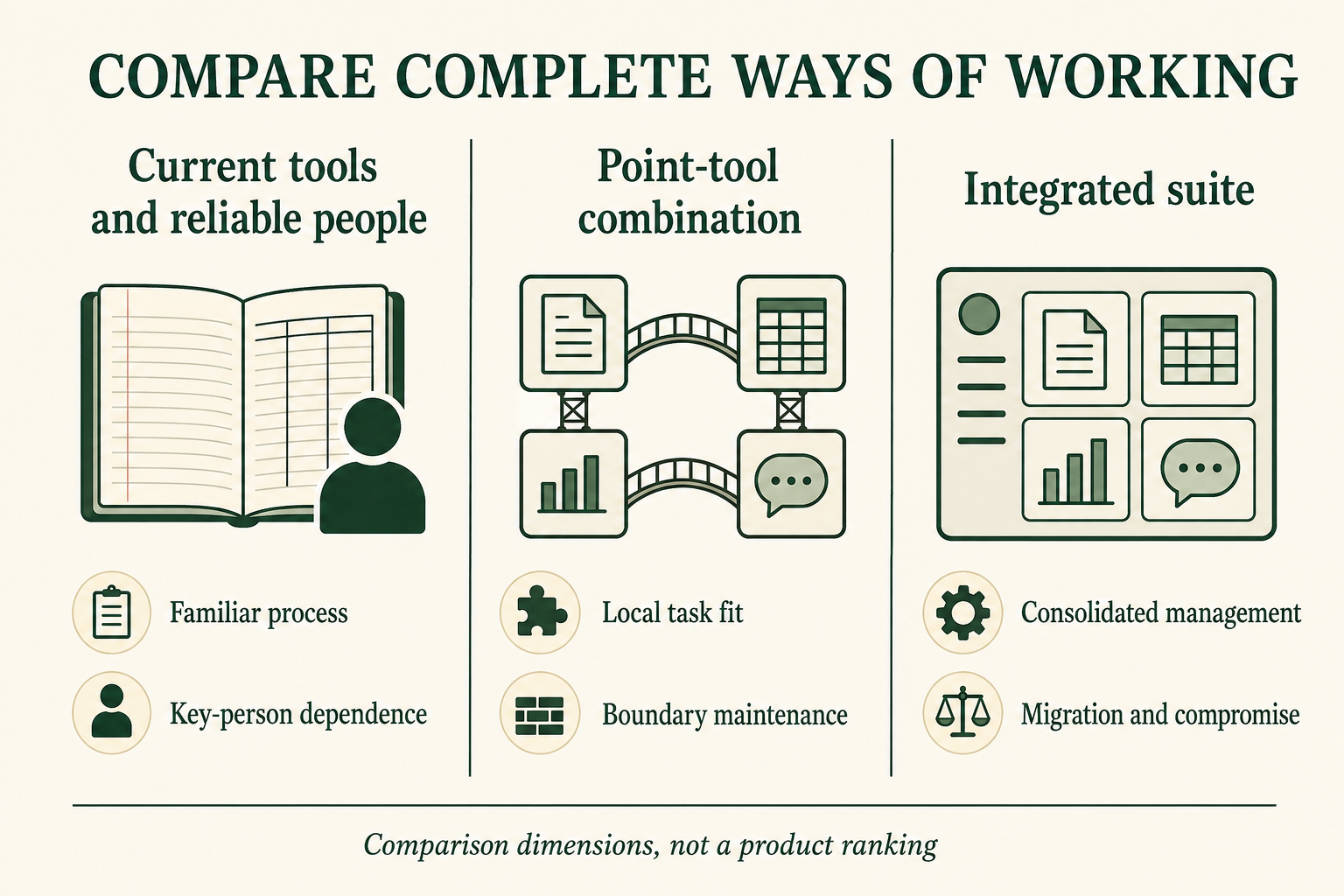
A purchasing exercise limited to competing brands can miss the strongest alternative: a familiar process supported by experienced people. A spreadsheet and a professional service may be sufficient. Selected point tools with clear handoff rules may fit better than a comprehensive replacement. An industry platform may cover the central workflow while unrelated tools remain independent. Each is a complete arrangement worth evaluating on its own terms.
Keeping the current approach can preserve familiarity and avoid transition risk, while retaining capacity limits, duplicated work, or key-person dependence. A point-tool combination can fit individual tasks closely while leaving cross-tool boundaries to maintain. A suite may reduce some switching and procurement work while introducing migration and standardization costs. These are proposed comparison dimensions, not universal findings about every product in a category.
Doing nothing is therefore not the absence of a decision. It means continuing to bear the current costs. Buying software means accepting a new distribution of costs and capabilities. Both choices need evidence. The age or visual polish of the incumbent arrangement does not establish whether it is the weaker choice.
If a local improvement resolves the important handoff, replacing everything to satisfy an operating-system narrative is unnecessary. If maintaining the boundaries between tools is already consuming substantial attention, integration has a more concrete case. The direction of the decision should follow that observation rather than an assumed ladder of digital maturity.
Saved time needs a path to a business benefit
Reducing the time spent on a task does not automatically create an equivalent cash saving. Staff may remain employed for the same hours, and fragments of saved time may not become usable capacity. Less overtime, avoided external work, faster feedback, and more capacity for customer service are different benefit pathways. A budget should explain which one is plausible and how it will be observed.
Multiplying every saved minute by a wage figure can make an estimate look rigorous without establishing that the benefit can be realized. The company needs to know what work disappears, what attention becomes available, and what it can actually do with that availability. A qualitative improvement in continuity may be meaningful even when it cannot honestly be reported as immediate profit.
Growth claims require similar restraint. Demand, pricing, marketing, staff capability, and seasonality can change results alongside software adoption. A narrower observation is often more credible: a repeated entry has been removed, an issue is easier to locate, or another person can continue the work during an absence. Such evidence can support a local buying decision without attributing all company growth to the product.
There is also a timing problem. Migration, cleanup, and training are incurred before stable benefits can be observed. A business with limited cash or management capacity may recognize the long-term proposition and still be unable to take it on now. That is a real constraint, not a failure to appreciate efficiency. A smaller first result and clearer exit conditions may make the decision feasible.
Buy one complete handoff before expanding the scope
A useful pilot is not a tour of every feature. It follows one bounded handoff across roles, with a clear beginning, an understood end, known owners, and an existing alternative. The subject might be a customer change reaching the next operator or completed fieldwork becoming understandable to a manager. The objective is a complete path through actual work, not a set of populated demonstration screens.
Before beginning, list the uncertainties that could invalidate the purchase case. Can relevant historical information arrive in a usable form? Will the critical role adopt the process? Can somebody other than the original configurator maintain it? Do external collaborators need new accounts or permissions? These are evaluation questions, not inconveniences to discover after the decision has become difficult to reverse.
Real customer and employee information must remain within existing authorization and privacy boundaries. Convenience during a trial does not justify uploading records without permission. Similarly, a successful test with sample data should be reported as a test, not as an observed live operational result. Preserving those distinctions protects the credibility of the purchasing evidence.
Expansion, a narrower deployment, parallel tools, or stopping the migration can all be legitimate outcomes. Define beforehand which work must disappear, which new burden is tolerable, and which safety or handoff conditions cannot be compromised. An exception that never occurred remains untested. A smooth path through one case is not proof that the whole company should move.
Exit options belong in the quality of the purchase
Continued use creates records, habits, and connections. Some resulting dependence reflects real accumulated value. Some reflects the difficulty of moving. Buyers need not reject every product with switching costs, but should understand which information they can obtain, in what form, with what relationships and attachments, and under whose authority. They should also know which services cease when the agreement ends.
Support for export is only the beginning of that inquiry. A downloadable file may still be difficult for another responsible person to interpret. Closing an account is not the same as completing an operational handoff. A proportionate check can test a small, authorized export without disrupting production and confirm the applicable contractual and retention arrangements. No particular vendor is assumed here to pass or fail those checks.
Keeping an exit option also improves internal decision making. The team can treat the purchase as a relationship to reassess rather than a decision it must defend forever. Work, staff structure, and commercial terms change. A once-appropriate arrangement may cease to fit. A product with continuing value should be able to explain why staying is worthwhile, not merely make leaving difficult.
An operating system is shared practice, not an application count
The common problem across industries is not that every company needs the same menu. It is that responsibility must move reliably through a business with limited money and attention. Industry software, configurable platforms, suites, and existing tool combinations allocate that burden differently. Their suitability depends on the work, the people, maintenance capacity, and the changes the organization expects to face.
A sound conclusion names the handoff worth paying for, explains why an alternative is insufficient, identifies the first observable result, and preserves the costs that remain uncertain. It also states what evidence would change the decision. Without those elements, a comprehensive software map is only a purchasing aspiration. With them, even a modest tool can become a useful part of the company's operating foundation.
Sources and limits
Official documentation was checked on September 7, 2026. Jobber, Zoho One, and monday.com supply narrow examples of workflow structure, licensing basis, and action consumption respectively. They are not presented as interchangeable products or as a ranked recommendation. Illustrative business scenarios and diagrams are analytical models, not reports of completed customer pilots.
No old revenue, customer count, market-size estimate, or claimed improvement is used as current evidence. Actual availability, quotations, contracts, privacy requirements, and professional responsibilities must be checked for the specific organization. This article offers a commercial evaluation framework, not individualized investment, legal, or compliance advice.
Choose a real cross-role handoff, compare the incumbent, point tools and an integrated option on complete costs, and test one bounded path with a workable exit.
This is a commercial assessment framework, not a brand ranking or individualized purchasing, investment or legal advice. Official facts cover workflow, licensing and action rules, not measured customer benefits.