What judgment does this research establish, and what evidence would invalidate it?
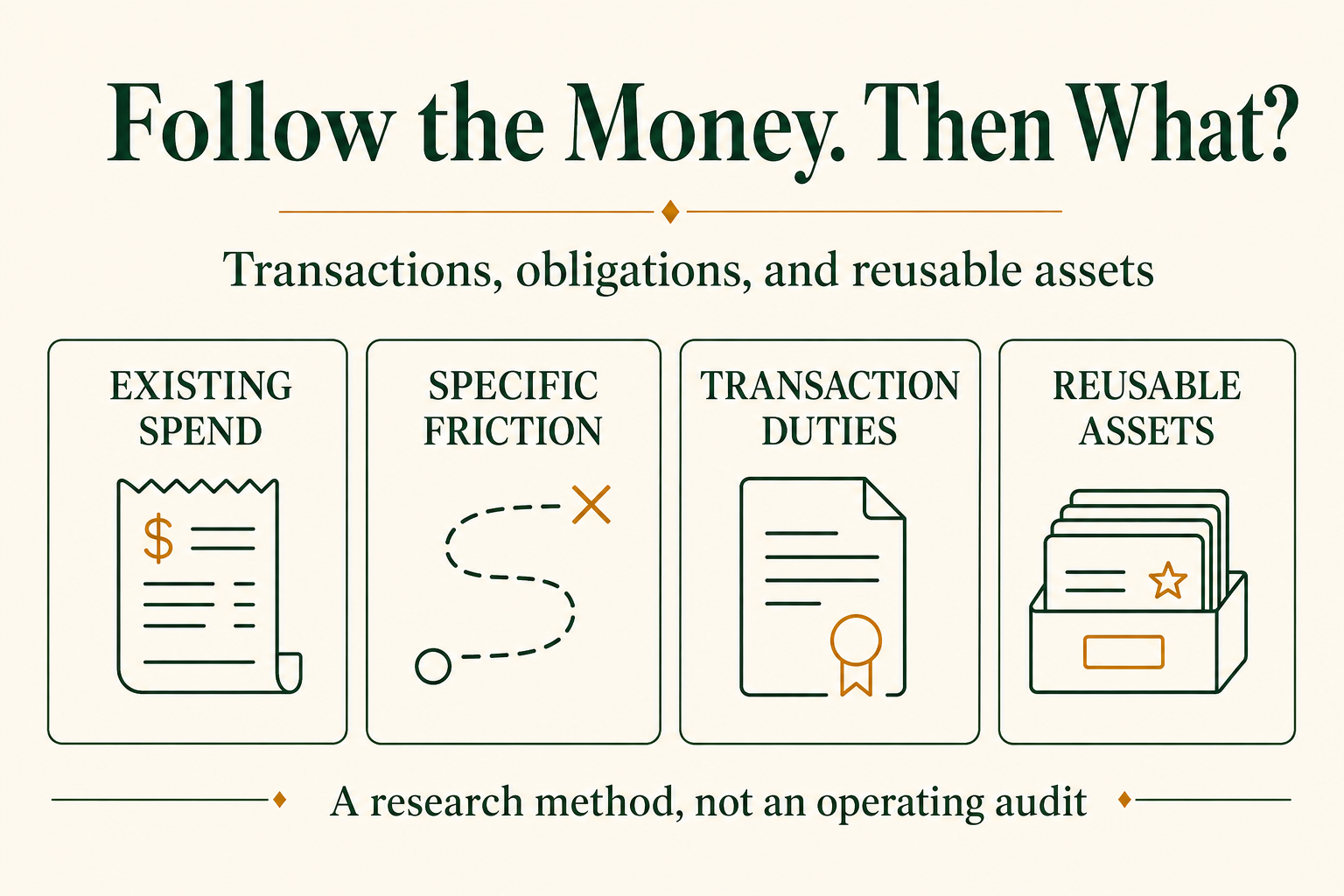
Follow the Money. Then What? Transactions, Obligations, and Reusable Business Assets
Finding people who already spend money is a useful starting point for a business. It is also an incomplete argument. A customer may willingly buy the underlying product while having no reason to pay for a new intermediary, interface, or purchasing route. Existing expenditure establishes that one exchange happens. It does not establish that another business deserves a place inside it.
A money-flow-first approach begins with that observable exchange. What is the buyer trying to obtain? Where does the process become expensive, slow, or difficult? Can a new service make a specific improvement while accepting the obligations attached to its promise? The method is valuable because it directs research toward behavior, not because it eliminates the need to test demand.
The starting material for this essay is a methodological note discussing Folyd. It is not an operating audit, and it contains no external evidence sufficient to independently verify the businesses discussed. This essay therefore makes no claims about Folyd's revenue, scale, supply arrangements, or distribution performance. Public platform documentation supplies narrow examples of transaction mechanics, not evidence about those businesses or a guarantee of success.
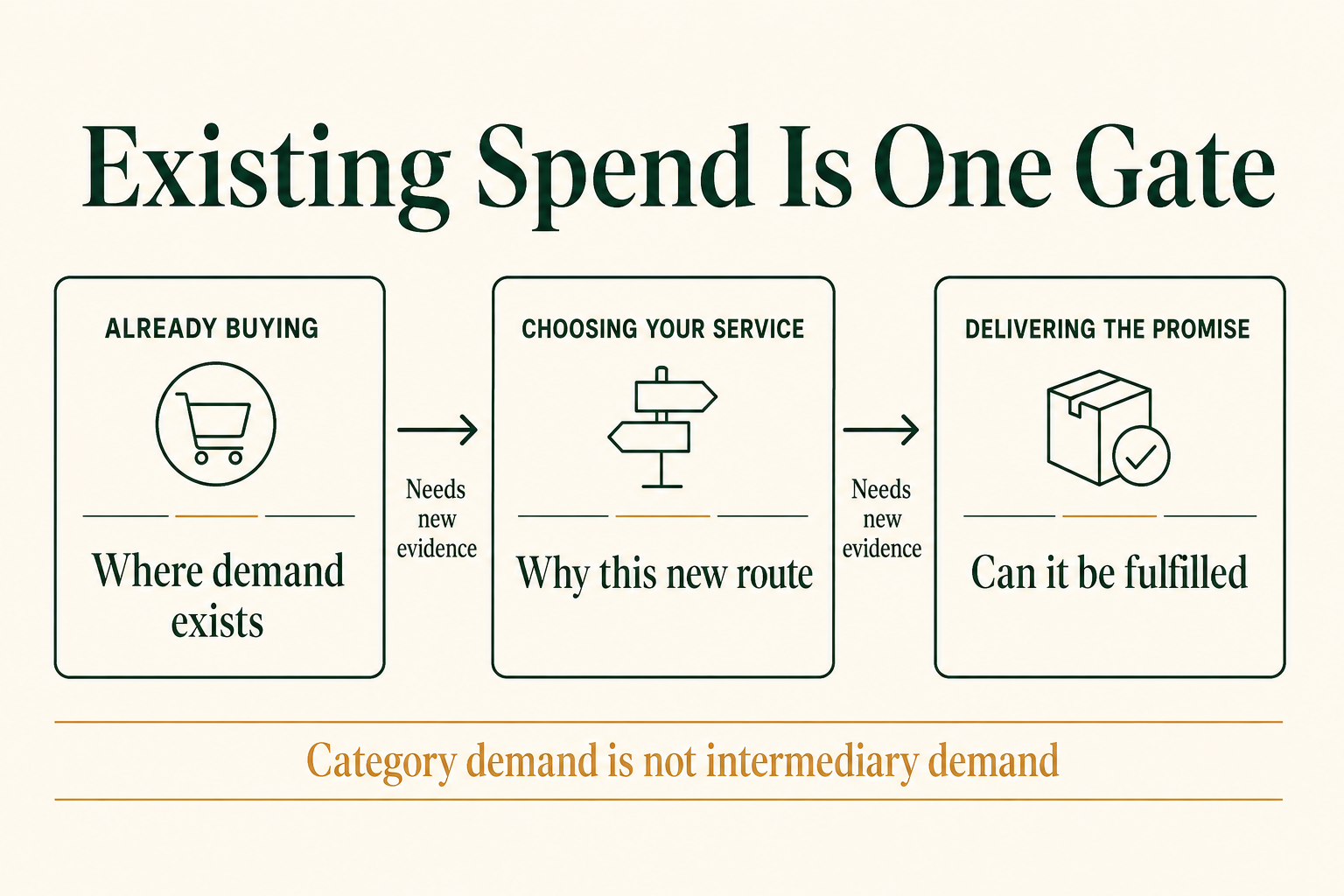
1. Existing spend answers only the first question
Begin by reconstructing a transaction. Who approves the budget, uses the result, selects the supplier, and receives payment? What exactly changes hands? Software bills, procurement records, and recurring manual work can all provide clues, but they are not interchangeable. A payment is an observed exchange. Labor time valued at a salary rate is an estimate of burden, not necessarily a budget available for a new product.
Spending also does not establish intolerable dissatisfaction. Buyers may receive reasonable value while occasionally complaining. They may know a cheaper option exists and still prefer reliability, familiarity, or an established approval process. The research needs to explain that choice. Treating every price difference, delay, and manual step as waste can remove something the buyer deliberately values.
A second question concerns the proposed route. Why would the buyer choose it? A service that removes a small inconvenience but requires sensitive information, a new contract, or dependence on an unfamiliar supplier may increase the total burden. A favorable interview response is not proof that the customer accepts those costs. Actual comparisons, requested quotations, and bounded purchases provide different kinds of evidence and should remain distinguishable.
A third question concerns delivery. An intermediary can persuade someone to buy and still fail to fulfill the promise reliably. It can also fulfill the promise through exceptional amounts of hidden manual work. Category demand, preference for the new service, and delivery capability are separate propositions. Keeping them separate makes a disappointing result easier to interpret: no need, no reason to switch, and unreliable fulfillment require different responses.
Money-flow-first research therefore changes the starting point rather than removing the remaining gates. Existing transactions identify where useful questions can be asked. The proposed business still needs evidence of its own. This matters especially when new technology is inserted into familiar procurement: an established budget should not conceal the new responsibilities and switching risks the service creates.
2. Match the business structure to the actual friction
An apparent price difference may reflect different service scope, purchasing scale, or risk allocation. Comparing headline unit prices is not enough. An optimization service needs to show what cost it removes while preserving the buyer's required outcome and conditions. A temporary discount or unstable supply advantage is different from a repeatable delivery capability. Research should ask what remains valuable if the original price gap changes.
Access problems also require diagnosis. A cumbersome approval process, incomplete purchasing information, and an explicitly prohibited transaction are different situations. Legitimate assistance may organize documents or coordinate delivery. Technical feasibility does not make account restrictions, regional rules, or upstream terms irrelevant. Specific eligibility and legal questions require appropriate verification; the method is not a rationale for bypassing them.
When buyers and sellers struggle to find one another, compare terms, or coordinate fulfillment, matching may be a plausible business structure. But a directory is only part of that work. Someone must accept a candidate, reach an agreement, and complete delivery. More transactions do not by themselves establish better matching: subsidies, manual intervention, or additional supply may explain the change. A circular diagram is not evidence of a network effect.
Fragmented information may instead support research, search, or a maintained information service. The paid promise could be a complete comparison, traceable sources, or less repeated organization. It need not be the transaction itself. A project fee or ongoing service charge may fit that promise better than a commission. The structure should follow the work, not an ambition to call every service a marketplace.
These categories can overlap. One purchase may involve discovery, access, and delivery problems. A small team still benefits from choosing a narrow segment it can reliably handle. Explicit scope clarifies both the reason to pay and the work that remains with the customer. A limited service is not necessarily a minor service; its importance depends on the transaction it helps complete.
3. Draw obligations alongside the movement of money
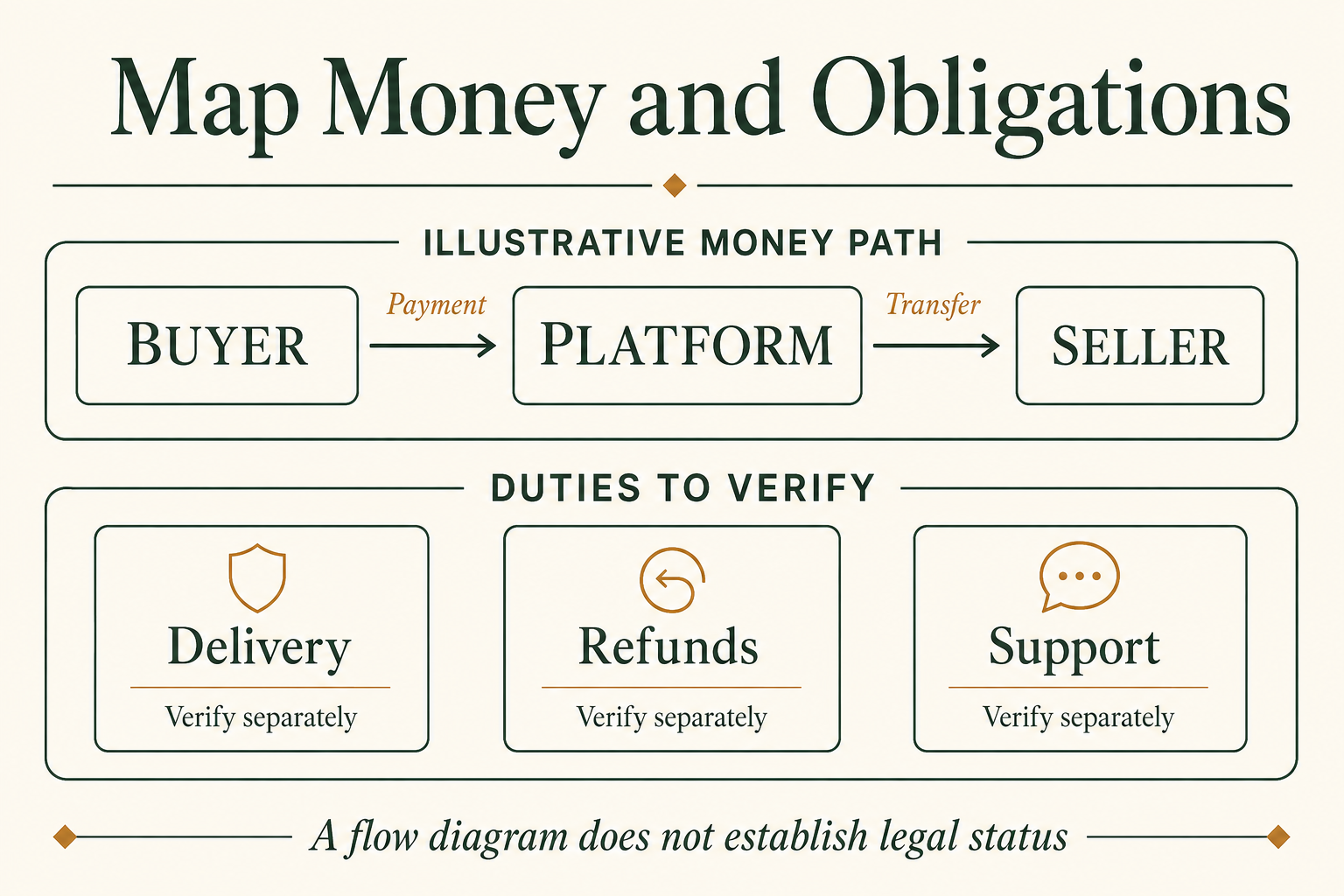
A first money map can identify the buyer, service operator, and underlying supplier, recording each payment and transfer. The arrows are not enough. Who promises delivery, receives complaints, funds a refund, or explains an interruption? These responsibilities may relate to payment routing, but neither interface branding nor the appearance of money in an account establishes every legal and operational obligation.
Stripe Connect's documentation gives a concrete example of this distinction. Direct charges are created on a connected account; destination charges are created on the platform with funds transferred onward. The account debited for refunds and chargebacks differs between those routes. This verifies a payment-system behavior, not the legal status of an unrelated proposed business. [Stripe charge-type documentation](https://docs.stripe.com/connect/charges)
During research, maintain a payment record and an obligation record, then compare them. The first describes sequence, amount definitions, and destinations. The second identifies responsibility for delivery, refunds, support, and exceptions. Unknown entries should remain unresolved. Labels such as platform, agent, or software provider cannot substitute for actual arrangements, applicable rules, and the working process.
Timing belongs in the picture too. The buyer's payment, the supplier's receipt, completion of the service, and a possible later refund need not coincide. An exchange can be sensible in the end while requiring the operator to fund an intermediate period or manage uncertainty. A diagram focused only on the moment of sale can omit obligations that remain afterward. No funding requirement is calculated here; these are facts to investigate.
A useful exercise follows the failure path. If supply becomes unavailable, the buyer rejects the result, or a payment is disputed, who must act next? A tabletop exercise is not an actual incident and cannot replace professional advice. It can nevertheless expose promises with no clear owner. If ordinary delivery works only through the founder's improvisation, a dependable operating system remains a hypothesis.
4. Keep transaction value, fees, and available cash distinct
The buyer's total payment is not necessarily the operator's amount to retain. Money temporarily visible in an account may still carry obligations. Research should distinguish the value of the exchange, the agreed service fee, direct delivery costs, and the timing of available funds. Accounting treatment depends on the actual arrangement. This essay does not prescribe recognition rules or label a simplified remainder as net profit.
Distribution belongs in the cost picture. Gumroad's current pricing page applies different fee conditions to sales through a seller's profile or direct links and purchases by new customers discovering the seller through its Discover marketplace. This establishes a public distinction between transaction sources. It does not establish that a particular seller's marketplace sales are incremental or more profitable. [Gumroad pricing](https://gumroad.com/pricing)
Consider a hypothetical digital-product seller comparing channels. The relevant record includes where the purchase originated, what acquisition work the seller already performed, any discount, and the support required afterward. A direct sale with a lower platform fee may depend on years of audience-building. A marketplace sale with a higher fee might reach a previously inaccessible buyer. Neither conclusion follows from the fee schedule alone.
Similarly, the gap between a resource's purchase and sale prices may fail to cover refunds, exceptional handling, customer support, and supply maintenance. Small operators can accidentally treat their own rescue work as free. Every order then appears to leave money while every additional customer creates invisible labor. Recording that work does not imply immediate automation. It makes the actual business model legible first.
Examine unfavorable changes as well: a promotion ends, supply becomes more expensive, a major channel reduces exposure, or support demand increases. Would the promise still be feasible? This is a conditional exercise, not a forecast or investment recommendation. Its purpose is to identify what the conclusion depends on, separating a service that can be improved from an opportunity resting entirely on a temporary difference.
5. A transaction record becomes an asset only through useful reuse
An order can leave behind a clearer classification of needs, delivery steps, exception handling, customer trust, or information the operator is permitted to retain. These may help with another job. Their existence does not establish an asset. Reuse starts to become observable when the material actually reduces repeated research, communication, or errors within an appropriate setting.
Data is particularly easy to overstate. Many transaction records do not guarantee complete fields, consistent meanings, or permission to use them for another purpose. Customer information may require restricted access, deletion, or use limited to the original service. Speculation about future value does not dissolve those boundaries. A smaller collection with clear sources, dates, and applicability can be more useful than indiscriminate accumulation.
A workflow can emerge from delivery as well. In a hypothetical procurement-assistance service, repeatedly missing application materials might lead to a preparation checklist. Whether another customer submits complete materials more easily still needs observation. The checklist's existence is not proof of lower delivery costs. Where customer requirements vary considerably, excessive standardization can create new mistakes and additional work.
Trust and distribution deserve the same specificity. An existing customer agreeing to discuss an adjacent problem is a sign of relationship continuity, not an automatic purchase. A public research article attracting a suitable inquiry does not prove that search traffic will keep growing. Ask which real task the asset reduces, when it works, and what maintenance it requires before assigning it a compounding-value label.
Failures and exceptions can be particularly useful material. They help identify when to accept an order, narrow its scope, or decline a promise. A reusable asset should improve those judgments, not merely make the sales pitch more fluent. The strongest evidence comes from another actual transaction in which the retained knowledge changes the work in a visible, relevant way.
6. A portfolio can share assets and share fragility
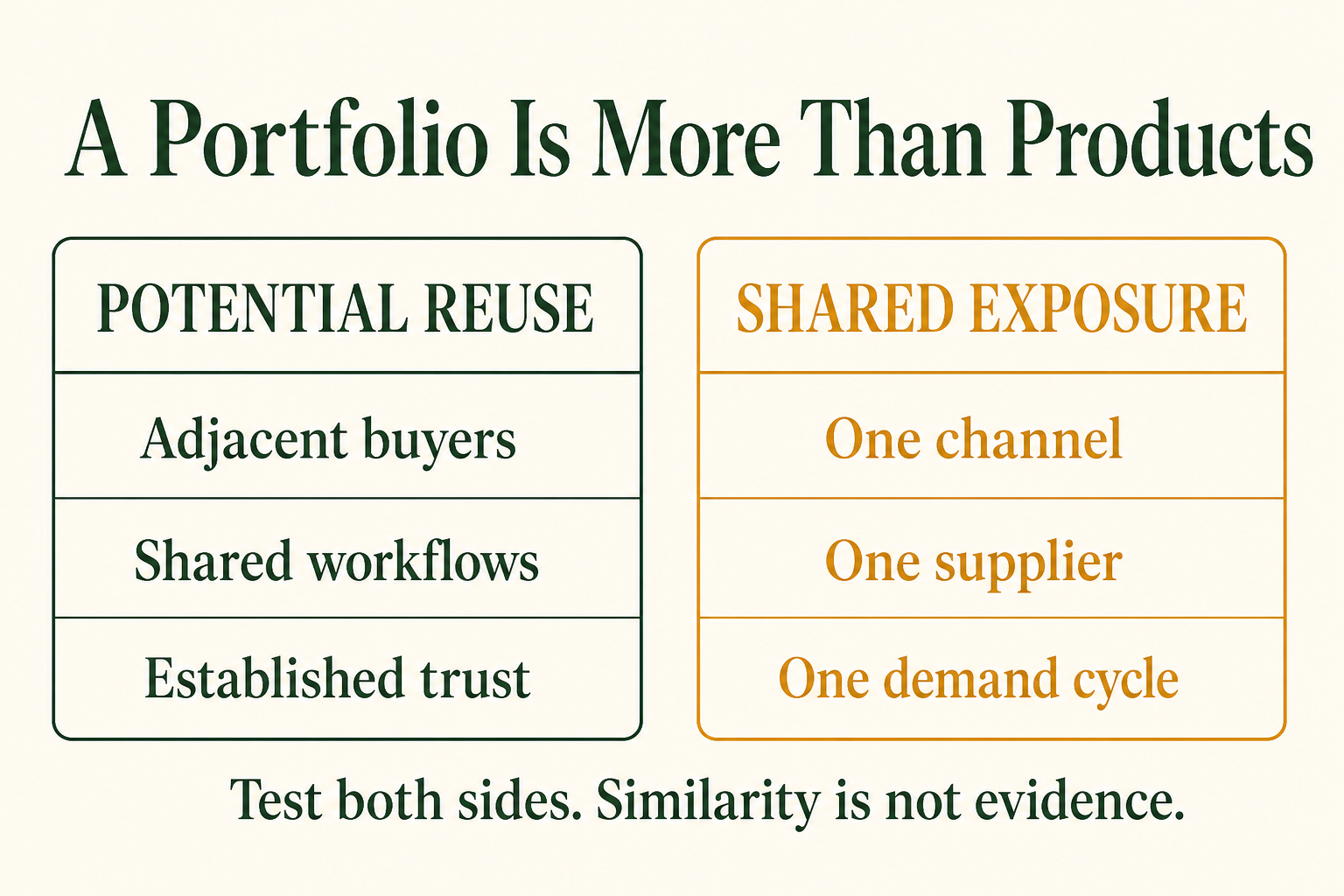
Products serving adjacent buyers may reuse relationships, explanatory language, and parts of a workflow. Adjacent does not mean identical. One person evaluating a development tool may focus on technical requirements, while buying an external service introduces organizational approval and operating a publication raises different priorities. A shared identity supplies a research lead; it does not prove shared budgets, trust, or purchase timing.
For a proposed second service, ask whether existing customers actually encounter the problem, whether the relationship makes discussing it appropriate, and whether prior capabilities help deliver the solution. If the argument is merely that both products use similar code or involve artificial intelligence, the commercial connection remains weak. Acquisition, explanation, support, and maintenance matter alongside development reuse.
Shared assets can also mean shared exposure. Two services relying on one supplier, one distribution channel, or the same category of customer budget may be affected together by a change. More product names do not automatically diversify the business. Place potential reuse beside common dependencies rather than drawing only cross-selling arrows. This comparison has no universal score and does not replace operating evidence.
The founder's attention is another shared resource. Partial automation of orders does not eliminate the judgment required for different exceptions. Investigate whether the new service can use established handling rules or repeatedly demands another context. If every business requires its owner to personally explain boundaries, a portfolio may distribute custom labor across more labels rather than create a more reusable operation.
A more bounded expansion hypothesis starts with a specific adjacent need inside the existing service. Test whether shared capabilities actually help within a limited scope. The new service needs its own payment and delivery evidence; the first product's success cannot certify it in advance. Portfolio value lies in the relationships that demonstrably work, not the length of the product list.
7. Start with one narrow transaction and keep the rejection conditions
Choose an actual transaction that can be studied without exposing private information. Record the buying goal, existing route, specific obstacle, alternatives, and decision-maker. Where possible, observe the steps in addition to interviewing participants. Keep what a customer dislikes separate from what they will change their behavior to obtain. Necessary controls and explicit prohibitions should not be relabeled as meaningless friction.
Then state a limited promise: which step the service handles, what it excludes, and how failure is addressed. Under appropriate permissions and conditions, observe a real purchase and delivery before treating a complete platform as necessary. The first transaction may depend on a personal relationship, a discount, or intensive assistance. Record those conditions rather than turning a single success into a claim of scale.
The next independent transaction is informative in a different way. Which capability is reused? What starts from scratch? Are exceptions easier to identify, and why does the buyer choose the route again? If another order only adds work, the business may still be worthwhile, but it may resemble ongoing service provision. Using software does not establish independence from manual delivery.
Keep conditions that could reject the opportunity: buyers refuse to switch, fees cannot support the promised service, supply conditions prohibit the intended use, or shared assets make no practical difference. Stopping a direction can be a useful result of research. Following existing money helps when it reveals the exchange, obligations, and accumulation more clearly—not when it is used to waive every remaining demand for evidence.
Sources and limits
The originating Folyd note is a methodological synthesis, not an operating audit, and supplies no external links sufficient for independent verification of the businesses it discusses. Their scale, revenue, supply arrangements, distribution performance, and network effects are therefore not asserted here. Private operating mappings are excluded. Official facts were checked on September 7, 2026, using [Stripe Connect charge types](https://docs.stripe.com/connect/charges) and [Gumroad pricing](https://gumroad.com/pricing), supporting only distinctions in funds handling and channel fees. Seller and procurement examples are hypothetical. No real-order experiment, profit estimate, legal determination, or financial recommendation is presented.
Study a real transaction without exposing private data, map money and obligations separately, test a bounded service promise, and examine reuse in the next independent exchange.
The originating Folyd note is methodological and lacks links for independent business verification. Official examples support payment routing and channel-fee distinctions only; no operating audit, order experiment, profit estimate, or legal or financial advice is offered.