
What judgment does this research establish, and what evidence would invalidate it?
The Tool Is Right There. Why Doesn't the User Come Back?
A browser tool can make a convincing demonstration remarkably easy. Highlight a passage, press a button, and a translation appears. Start an email, and a writing suggestion arrives before you leave the text field. The interaction feels better. What the demonstration cannot establish is whether the person has another real job for the tool, whether the result deserves their trust, or whether there is a durable business behind the convenience.
That gap matters for founders building contextual utilities: products that help inside an activity already under way. Their ambition is not to become another destination. It is to make an existing task easier to finish. Yet a product that succeeds at being almost invisible may be particularly easy to measure badly. App openings, feature clicks, and time spent can tell a very different story from useful work completed.
This essay develops a research framework for that problem. Product descriptions were checked against official documentation on September 7, 2026. The causal explanations and proposed experiments are analytical hypotheses, not findings from those companies' internal data. The working examples are hypothetical, and no revenue, retention, or conversion forecasts are asserted.
Start with the work the user was already doing
Imagine a researcher comparing software businesses. She encounters a passage in another language, needs to understand its relevance, and then wants to continue the comparison. Translation is a step in her job, not the job itself. A fluent answer can still be an inconvenient product if she must repeatedly leave her sources, reconstruct the context, and find her place again.
Now consider someone drafting an email with an important qualification. He may welcome help identifying an ambiguous sentence, but not an assistant that silently rewrites the commitment he intended to make. The relevant outcome is an acceptable message sent with confidence. Producing more suggestions, or getting more suggestions accepted, is not automatically progress toward that outcome.
Define the research unit accordingly. A contextual job has a trigger, an intended result, a way to judge that result, and a return to the surrounding activity. Installation makes such a job possible; it does not complete one. Nor does invoking a tool establish that its output was used. Before constructing a funnel, identify what would count as an actual completion and what evidence would distinguish it from a demonstration, an accidental invocation, or a failed attempt.
Compare the complete job, not the output alone
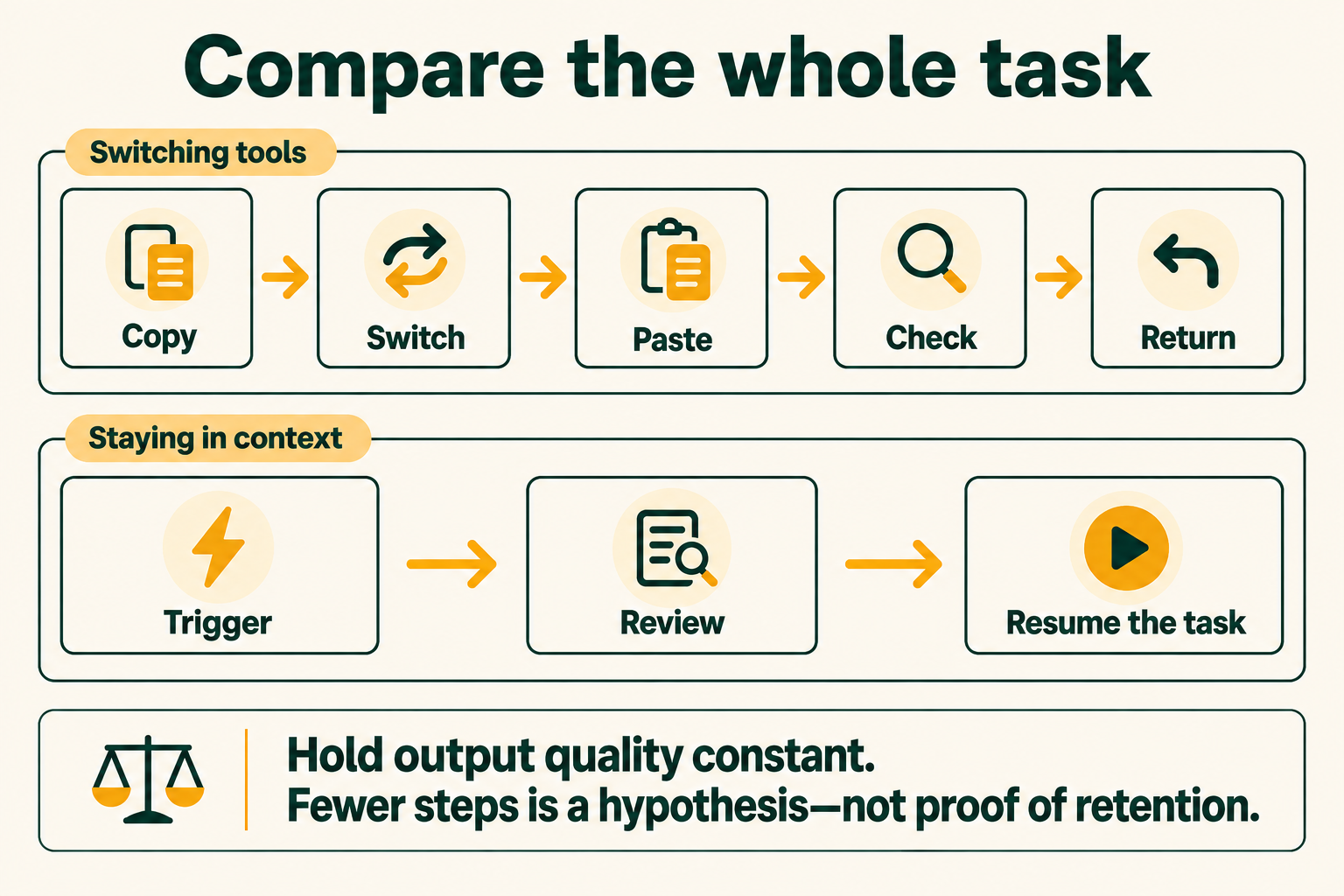
The familiar route through a separate utility involves copying material, changing context, pasting, checking the answer, and returning. Some of that effort is visible in the interface. Some is not: deciding what context to include, matching the answer to its source, noticing that something has changed, and resuming the train of thought that led to the question.
An in-place tool proposes a shorter route: encounter the problem, inspect the assistance, and continue. But shorter does not mean better by definition. A suggestion can obscure the material being read. An automatic replacement can create new review work. A translation that cannot be compared with the original may save a switch while making verification harder. The right comparison concerns the burden of finishing the whole job, not the number of clicks before an answer appears.
Hold the task and output quality as steady as possible when comparing these routes. Start observation when the need arises, and stop when the person can genuinely continue their original work. Record corrections, rejected output, abandoned attempts, and interruptions alongside elapsed time. The two paths in the accompanying diagram describe a mechanism worth testing; they are not evidence of a measured productivity gain.
This also changes how to interpret a slower interaction. An extra review step may add useful control when a mistake would be costly. Removing it could improve a speed metric while degrading the job. The design question is not whether every step can disappear. It is which steps merely move information around, and which help the user make a decision they still need to own.
Use product examples for the claims they can support
Grammarly's extension guide describes writing suggestions appearing within website text fields, with controls to accept or dismiss them. Immersive Translate documents bilingual web reading and contextual translation interactions. DeepL's browser page describes translating selected text and accessing writing assistance. These are useful, bounded facts about where help appears and how it relates to the user's material. [Grammarly's guide](https://support.grammarly.com/hc/en-us/articles/115000091592-Grammarly-s-browser-extension-user-guide), [Immersive Translate's documentation](https://immersivetranslate.com/en/docs/), and [DeepL's browser product page](https://www.deepl.com/en/chrome-extension).
They do not establish a ranking of retention, profitability, or feature-level effectiveness. The comparison is more informative when it asks what each interaction lets a user inspect and continue. Inline writing assistance, bilingual reading, and selection-based translation present different relationships between the original material and the result. Counting capabilities would miss that distinction.
Resist the temptation to turn every comparative study into a winner, challenger, and failure story. A missing failure case is an evidence gap, not an invitation to invent one. Likewise, an attractive interface is an observation about the product, not proof of the causal mechanism proposed by the researcher. Public documentation can establish that a capability is offered. It cannot substitute for experimental or cohort evidence about what that capability changes.
Activation has a timing problem
A person can install the right tool at the wrong moment. They may have no relevant task that afternoon, be unsure where it works, or stop at a permission request they do not understand. Those are different situations. Treating all three as failed activation obscures the intervention each would require.
Useful onboarding connects the product to work the person already intended to do. For a research reader, their own next source is a more revealing test than a polished sample paragraph. Ask whether the output actually entered their comparison, note, or decision. A successful demonstration proves the product can complete the demonstration; it does not show that it has found a place in the person's routine.
Permissions belong in this analysis too. A tool that processes page content should make the scope and control understandable. Hiding access requirements to increase completion would confuse less visible friction with less risk. In a sensitive setting, a clear confirmation may be valuable even if it slows the initial interaction. The goal is to remove unnecessary work, not the user's ability to choose.
Let the task define the return window
A daily research reader and an occasional traveler may value the same translation capability on very different schedules. A uniform next-day return metric can mistake opportunity for quality. Establish the natural task cycle for each group before deciding what absence means. Someone who has not encountered another relevant task is different from someone who encountered one and chose a competing method.
A repeated call also needs interpretation. It might be a second job, a retry after a poor result, or a test of whether the extension works on another page. All three increase usage. Only one unambiguously suggests a new opportunity served. At minimum, distinguish new tasks from retries and ask whether the user consumed the result and resumed their work.
The same caution applies to usage across multiple surfaces. It may indicate expanding usefulness, but it can also reflect attempts to work around an unreliable integration. Prove repeat value in a clearly defined setting before treating broader coverage as the next objective. Otherwise, the team may expand its compatibility list without knowing which part of the experience is worth reproducing.
A second use is a clue, not a causal finding
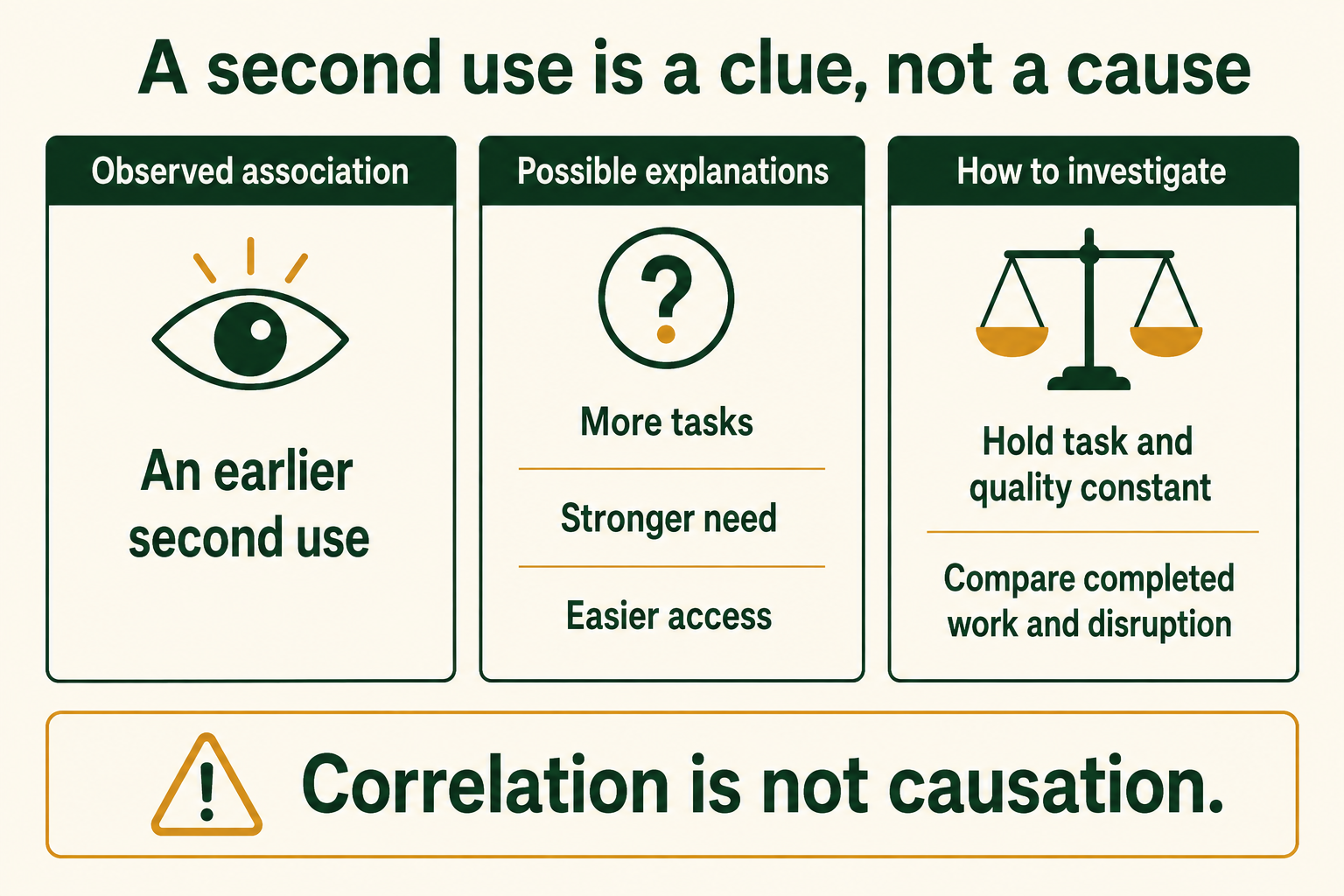
Suppose people who complete a second job quickly are more likely to remain active later. This is an important lead. It is not yet an explanation. They may have more work to do, stronger needs, greater software fluency, or a different acquisition source. Encouraging everyone to click a second time need not reproduce the characteristics that made that group valuable.
Write down competing explanations before choosing an intervention. Did easier access encourage repetition, or did an existing need produce both? Did the second task build trust, or did already-trusting users choose the second task? Was quality better for that group? These questions turn a promising association into a research agenda rather than a growth slogan.
To investigate presentation itself, compare in-place and separate-page experiences under reasonably similar tasks and quality conditions. Track actual completion, return at the natural task cycle, and interference with the surrounding work. If only observational data are available, retain the selection problem in the conclusion. A useful clue does not become less useful because its limits are stated accurately.
Refusal and recovery are part of a useful tool
Optimizing solely for acceptance can encourage a product to remove necessary scrutiny. A grammatically plausible rewrite may alter the intended commitment. A readable translation may omit a qualification. In either case, the user needs a practical way to compare, reject, and recover, not just a convenient route to applying the result.
Reversals should therefore be interpreted in context. An undo may reveal poor assistance, but the ability to undo can also make a person willing to use the product responsibly. Observe whether people can identify what changed and recover the original without substantial effort. A smooth first interaction that leaves them unable to correct the system is an incomplete account of usability.
Disabling the tool on one site deserves similar care. It may reflect privacy concerns, a need for concentration, an incompatible task, or persistent errors. These are not interchangeable with permanent abandonment. Treating every local opt-out as a churn event to be overcome can make a utility increasingly intrusive. Distinguish deliberate boundaries from unwanted failure before designing a recovery campaign.
Payment requires a new reason, not more clicks
Repeated free use can be a rational outcome for both the person and the product's basic promise. If the free version reliably handles the relevant work, persistence alone supplies no new reason to pay. More prompts or an artificially interrupted task may increase pressure without revealing a genuine unmet need.
Investigate the work that remains difficult. It might involve a more complex document, a different error tolerance, sustained processing costs, continuity across devices, or organizational responsibilities. These are possible research directions, not claims that a particular premium feature delivers a proven return. Start with the task and the consequences of failing it, rather than inferring demand from the name of a paid feature.
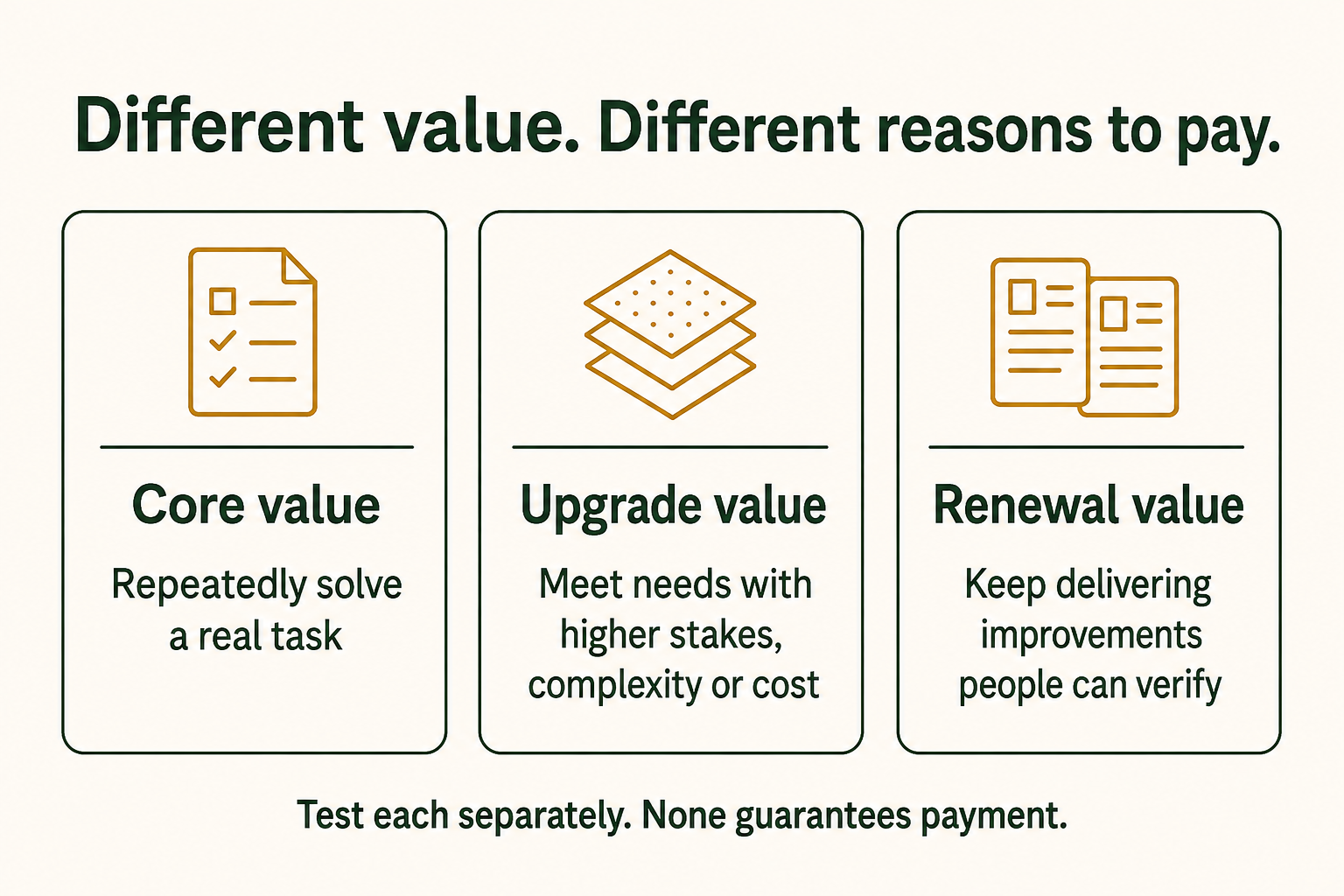
An initial purchase and renewal require separate explanations. An urgent document can justify a one-off payment without creating next month's demand. A team may need a security review even when an enthusiastic individual wants the product. Basic usefulness, a reason to upgrade, and continuing value are conditions to examine independently. They should not be drawn as an inevitable march from frequent usage to subscription revenue.
Run experiments that can change the decision
Begin with the uncertainty most likely to alter the product direction. For an in-place experience, a comparison with a separate page may be informative if the task, users, and output quality are held sufficiently steady. Define eligibility, assignment, completion, and unacceptable errors before the test. Measure the whole job and a subsequent natural opportunity, not just the time to the first result.
A second experiment can test whether onboarding helps users recognize their own next occasion to use the tool. Compare a light contextual reminder with the existing experience, but do not assign a compulsory demonstration and call it organic return. If invocations rise without more work completed, or the effect vanishes as soon as reminders stop, the team should reconsider whether it found value discovery or temporary prompting.
A third can examine how premium value is explained when a genuinely more demanding task occurs. Preserve a clear choice and a comprehensible free option. Alongside purchase, observe interrupted work, complaints, departures, and whether useful activity continues afterward. Choose thresholds from the product's baseline and the consequences of error before seeing results. A small sample should produce a bounded observation, not a claim that the business model has been validated.
Do not combine unrelated changes and then credit the most attractive narrative. Improving model quality, changing the entry point, and delaying a payment prompt at once may create a better product, but it will not isolate the effect of contextual presentation. Decide whether the immediate goal is improving the experience or learning a specific mechanism, and describe the evidence accordingly.
Keep a record that separates events from explanations
For each meaningful case, preserve the intended job, the previous workaround, the point of invocation, the result's use, the checking required, and the next genuine opportunity. If payment was discussed, record what was offered and why it was accepted or declined. Protect the underlying material: a shareable research record does not require publishing a customer's document or confidential workflow.
Keep observation, interpretation, and hypothesis distinct. A person translating another page is an event. Describing the product as their default reading environment is an interpretation. Claiming that less context switching caused future return is a hypothesis requiring different evidence. This separation makes it possible to revise a belief without rewriting what happened.
Attach a disconfirming condition to an important explanation. More calls accompanied by more rework would weaken the claim that repetition reflects value. A purchase followed by no further relevant tasks would challenge a recurring-use thesis. Record dates and product conditions as well: changes in native browser capabilities, permissions, or output quality may alter the comparison on which an earlier conclusion depended.
Know when a separate workspace is the better answer
Contextual convenience is not a universal product destination. An infrequent but complex task may need a substantial brief, a deliberate review, and a durable artifact that can be handed to someone else. A separate workspace can make those responsibilities more visible. Compressing the experience into a floating button may hide complexity rather than remove it.
The appropriate boundary also depends on what must persist. A quick correction, a long research process, and a shared organizational record do not need the same kind of product. An in-place helper may be an excellent entry point without being the whole system. Expansion should follow evidence about the work users need to retain, not an assumption that every successful utility must become a platform.
The resulting thesis is deliberately conditional. Assistance at the point of need can reduce starting effort and the work of restoring context. It has a chance to become durable value when the job recurs, the output is reliable enough, the person remains in control, and an upgrade addresses a real additional need. The next research step is not another integration. It is one clearly described task, an end-to-end comparison, and evidence that could prove the appealing story wrong.
Sources and limits
This analysis develops the earlier contextual-utility research notes. The official sources cited above establish product interactions as checked on September 7, 2026. They do not supply feature-level causal estimates or comparable retention cohorts. All working scenarios and experiments are illustrative; no company-level performance ranking, universal conversion target, or claim of a completed founder experiment is made.
Choose one real job, compare the complete paths to finishing it, and identify evidence that could overturn the convenience thesis.
This is an analytical framework using documented product interactions, not internal retention data or completed experiments. Scenarios and causal mechanisms are explicitly hypothetical.