
What judgment does this research establish, and what evidence would invalidate it?
The Missing Evidence Between Adoption and Governance
Developer tools are often described through a smooth growth story: one person adopts a product, a team follows, the organization standardizes on it, and enterprise governance becomes the next commercial layer. That story may describe some companies, but it is not a conclusion that can be inferred from registration, invitations, seat growth, activity, or a company-level retention metric.
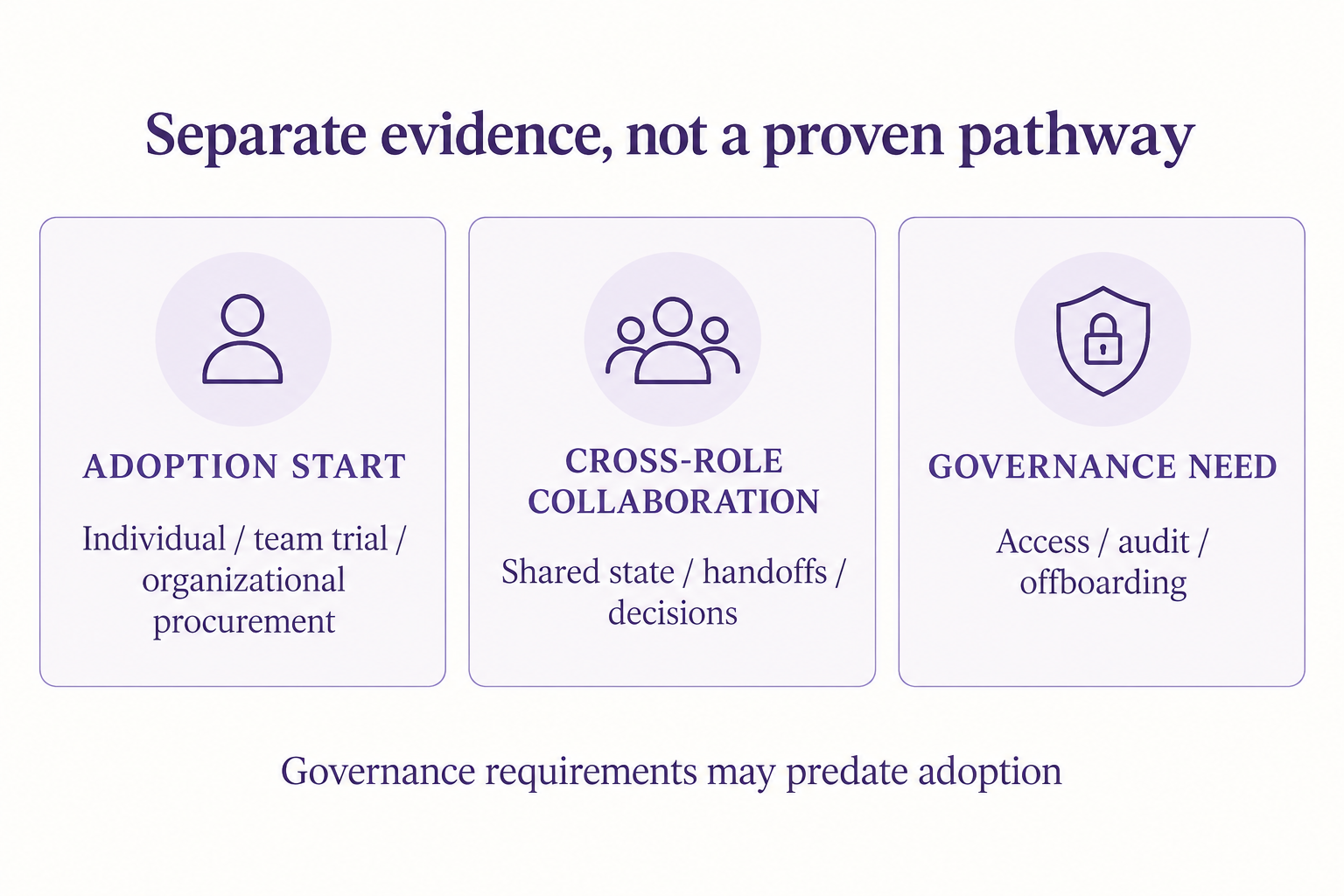
The evidence reviewed here supports a narrower claim. Individual adoption, sustained cross-role collaboration, and organizational governance needs are three different layers. Each requires its own evidence. Public material from Linear, Postman, and GitLab offers useful observations and hypotheses, but it does not establish a complete individual-first causal pathway.
1. Separate Adoption, Collaboration, and Governance
The first question is how adoption began. Was the tool introduced by an individual, tested by a team, or purchased and deployed by an organization? These are different starting conditions. Individual adoption may depend on an immediate pain point, low learning cost, or a distribution channel. A team trial may depend on project coordination, management support, and shared work. An organization-wide rollout may be driven by procurement, compliance, vendor consolidation, or an existing standardization program.
The second question is whether collaboration actually occurred. Registrations and seats are weak proxies. A stronger observation is repeated meaningful action by different roles on the same project or work object during a defined period. The relevant signals might include shared state maintenance, handoffs, decisions, reviews, or recurring coordination.
The third question is governance. Access controls, auditability, sensitive-data protection, offboarding, standardization, and machine-scale orchestration may become more visible as collaboration grows. But they may also predate adoption. A governance requirement appearing alongside collaboration does not prove that it evolved from individual use.
2. What the Linear Case Shows—and Does Not Show
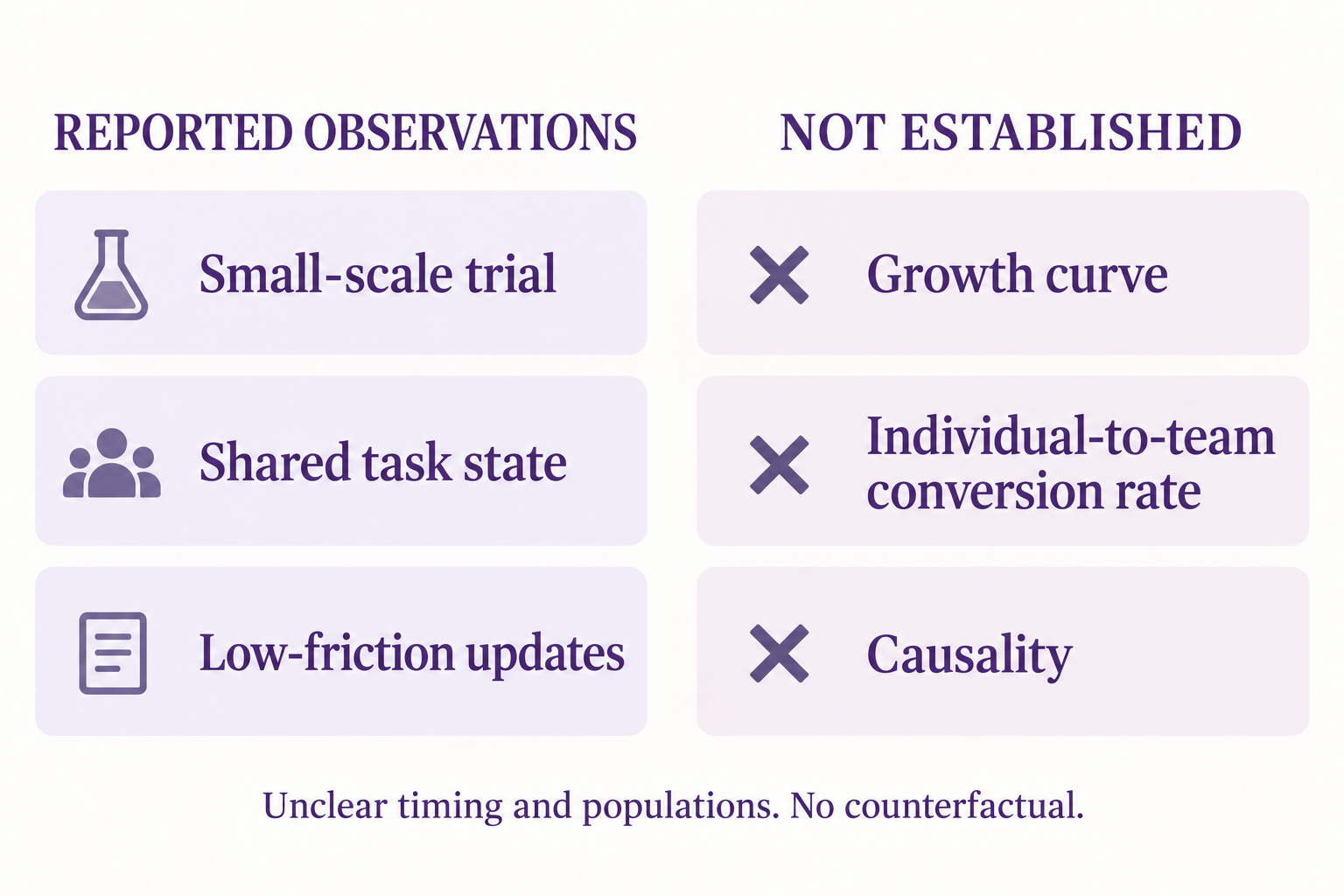
Linear’s published OpenAI customer case describes a progression from a small trial to broader organizational adoption. The page contains both a reference to more than 3,000 people and another reference to more than 2,000 people, without clearly specifying whether the figures refer to different dates, populations, or measurement methods. They should not be combined into a growth curve or used to calculate an individual-to-team conversion rate.
The case also reports an engineer’s view that creating and updating tasks involves very low friction. It describes recurring practices such as reviewing projects in meetings and sharing task status. The reported low-friction experience and shared-state practices are separate observations. The proposition that lower update friction helps teams maintain shared state is an inference to test, not an observed relationship or a verified causal mechanism.
It does not establish causality. The page does not show that individuals adopted the product before teams, nor does it provide a pre- and post-governance comparison. Team size, culture, training, procurement, project importance, and competing tools could all contribute to wider adoption.
The appropriate use of the case is therefore descriptive: it shows how a vendor presents trial, shared state, and organizational expansion. It does not prove that individual adoption necessarily creates a team standard.
3. The OVO Case: Collaboration and Governance in the Same Story
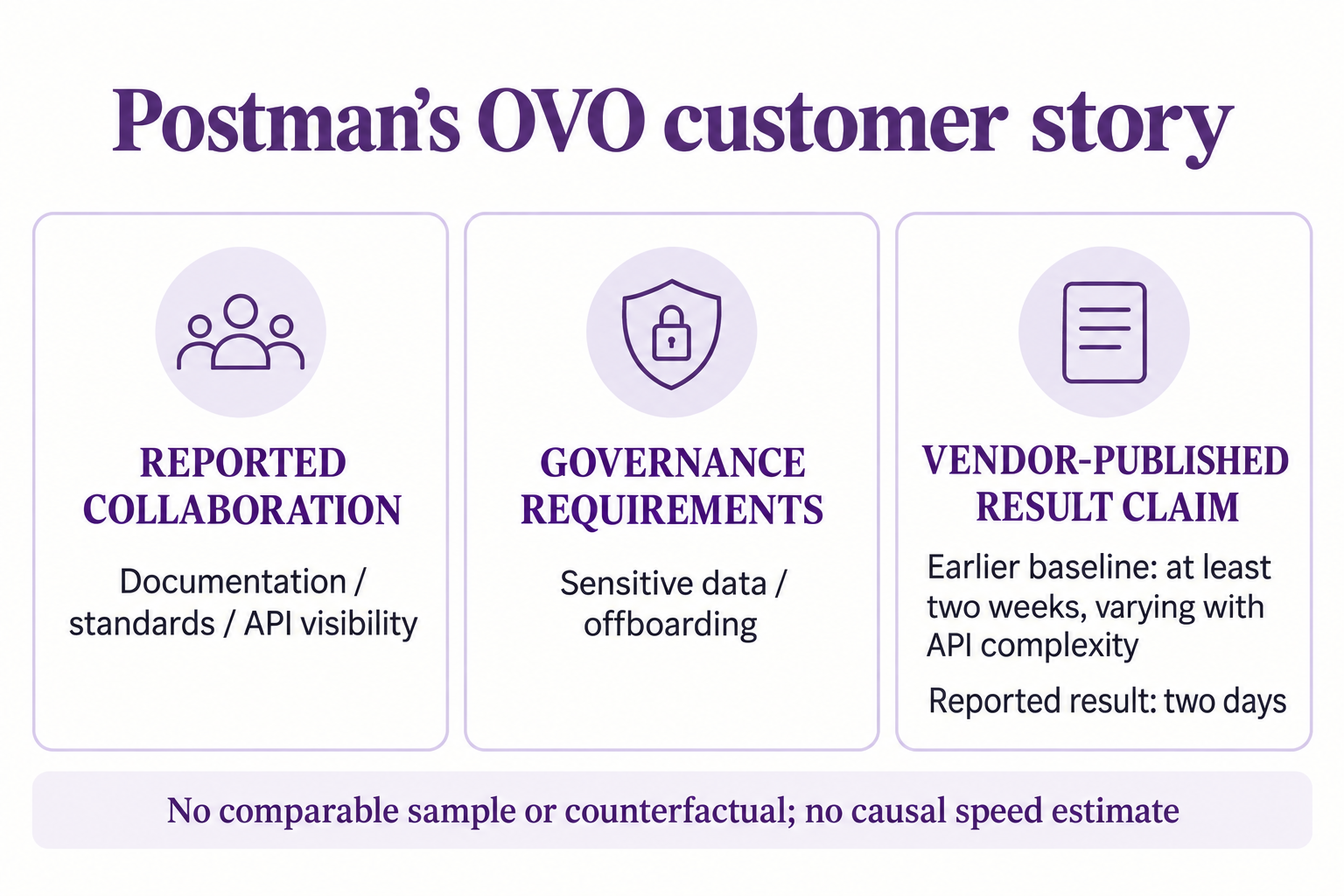
Postman’s OVO customer story describes developers previously using a fragmented set of tools, including free versions, followed by adoption of a paid plan. The story reports improvements in workspaces, role coordination, documentation centralization, standardization, and API visibility.
It also identifies sensitive-data protection and the removal of access for departing employees as requirements. The story suggests that API visibility can support governance. These statements must remain separate: a requirement being identified, a product capability possibly supporting it, and governance being fully implemented are different claims.
Postman further reports that the time OVO needed to bring new API services live fell from at least two weeks to two days. The original description indicates that the earlier baseline varied with API complexity, while leaving the sample, measurement window, method, comparable complexity, and counterfactual unspecified. The statement can be reported as a vendor-published customer result, but it cannot be converted into a universal speed multiplier or an independently established causal effect.
The research value of the case is that collaboration, standardization, visibility, and governance may be discussed together in one organization. The case does not establish that they emerged in the sequence individual use, team standard, and enterprise governance.
4. Postman’s Company History Is Not Cohort Data
A retrospective account by Postman’s founder describes a product that first solved the founder’s own development problem, then attracted coworkers, and later developed into an organization-oriented B2B product. This is useful historical narrative.
It is not a longitudinal cohort. The account does not report how often individual adoption developed into standardized use across teams, how many failed to continue, when governance needs emerged, or how much growth came from coworker adoption rather than other channels. The same account mentions Chrome-store discovery, which means channel exposure cannot be excluded as an alternative explanation.
The careful interpretation is a hypothesis: a founder’s pain point, coworker use, and broader cross-functional demand may be related. The account does not validate a general adoption path or show that growth primarily resulted from organic internal spread.
Historical stories should therefore preserve unanswered questions. Who adopted first? Who stopped using the tool? Which teams never formed a shared work habit? Did governance needs emerge later, or were they already present? Without those answers, narrative coherence should not be mistaken for causal evidence.
5. GitLab Shows That Governance Is a Market Conversation
GitLab management has publicly discussed large customers’ needs for security, governance, and orchestration at machine scale. This supports a narrow observation: enterprise governance is openly discussed as a commercial need by a platform vendor.
Company-level revenue, customer counts, and Dollar-Based Net Retention answer a different question. They do not show how individual users adopted the product, whether a specific feature caused renewal or expansion, or whether governance improved product-level retention.
A strong company-level metric can coexist with highly active teams, small teams that remain on a free plan, customers deployed through organizational mandates, and users who never develop governance needs. Treating a company metric as evidence of an individual-to-team pathway is therefore an evidence mismatch.
The number may be real while still failing to answer the question under study.
6. A Mechanism Framework: Behavior Before Seats
A more reliable framework separates three observable layers.
First, measure the adoption starting point: individual initiation, team trial, or organizational procurement. Record when each began. Second, measure the collaboration graph: whether different roles repeatedly act on the same work object, whether shared state is maintained, and whether handoffs or decisions depend on the tool. Third, measure governance pressure: when access control, auditability, sensitive-data protection, offboarding, standardization, or scale requirements first appear.
Low-friction updating should be treated as a mechanism to test, not a conclusion. It may help users maintain shared state more often. It may also be correlated with team culture, training, project importance, or management support. Governance pressure may become more visible after cross-role dependence increases, or it may have been the original reason the organization selected the tool.
A serious study should record alternative explanations: mandated procurement, existing compliance requirements, training, team size, price and seat friction, channel exposure, and switching costs. A mechanism claim needs time order, behavioral change, and an outcome measure—not just a successful customer story.
7. Counterexamples and Failure Conditions
If a case began primarily with mandated procurement, the individual-first interpretation must be narrowed. If governance requirements existed before individual or team adoption, governance should not be described as an outcome of collaboration. If growth was driven mainly by a marketplace recommendation, sales motion, or brand exposure, it should not be attributed to coworker-driven organic spread.
If a low-friction product is heavily used but does not generate repeated cross-role behavior, the low-friction collaboration mechanism is not supported. If adding friction reduces expansion, that may support one specific sub-hypothesis; it does not validate the entire path to enterprise governance.
If the evidence includes only successful customer stories, with no failed customers, non-upgraders, or organizations that never developed governance needs, the success rate cannot be estimated. Vendor selection creates a natural positive bias. Without genuine pre-event records, prediction calibration is also unavailable.
The pathway must remain falsifiable. Individual use may remain individual. Teams may use a tool without forming a standard. Governance may be imposed by external compliance rather than generated by internal spread. Payment may occur without proving retention or product effect.
8. What Product Teams Should Measure Next
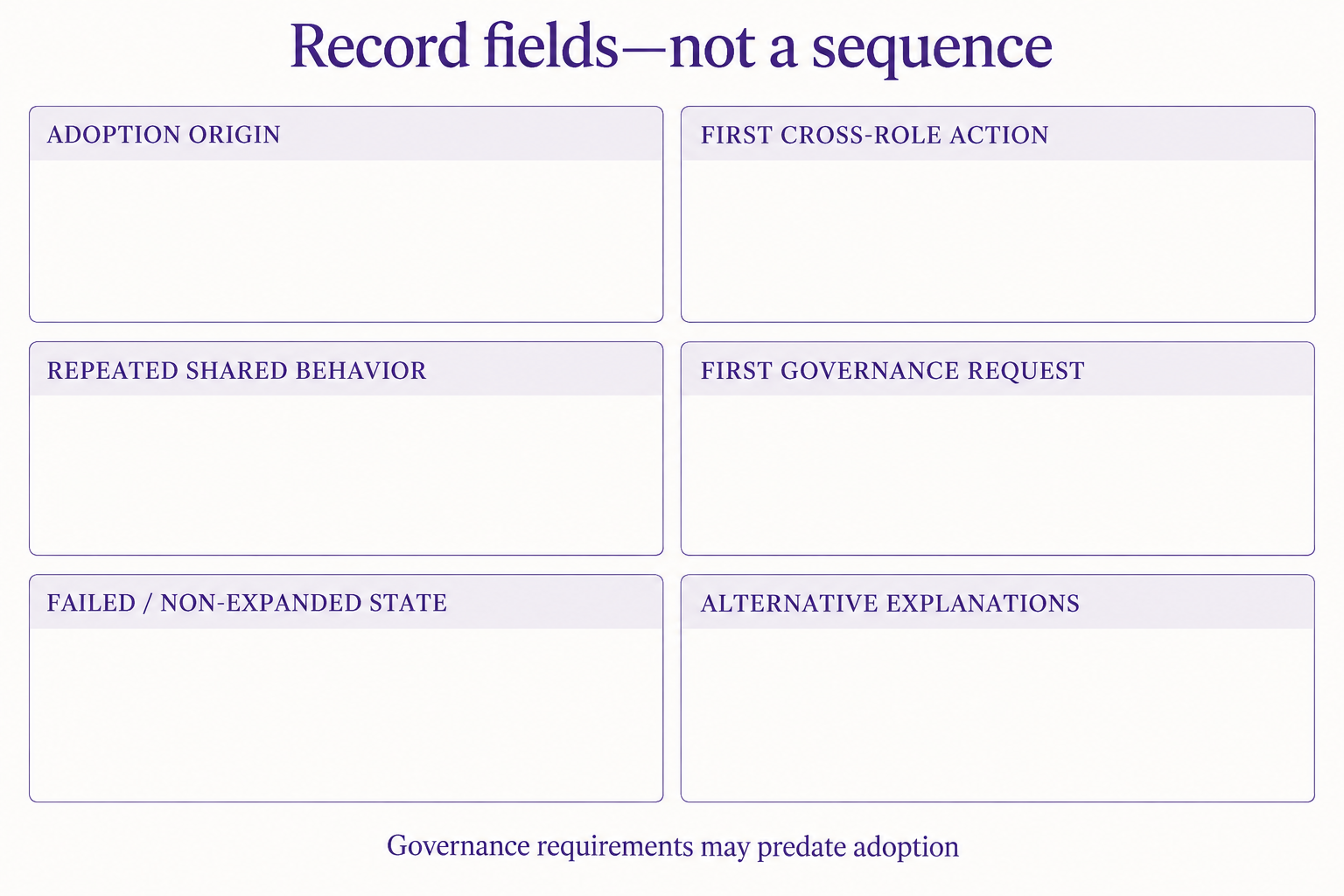
A product team testing whether individual adoption can become a team standard should first define observable behavior. At minimum, it should record the adoption starting point, role combinations, project period, repeated cross-role actions, shared-state use, and exit or non-expansion states.
A team testing governance value should record when the need first appeared and distinguish pre-existing compliance pressure from new pressure associated with collaboration scale. Activation of an access-control or audit feature does not prove improved retention or increased willingness to pay; those outcomes require separate behavioral and commercial evidence.
A team studying enterprise willingness to pay needs procurement rationale, budget source, alternatives considered, renewal or expansion behavior, and the role of governance in the decision. A single customer story, seat increase, or company-level DBNRR cannot substitute for Enterprise WTP evidence.
A practical research table might include: adoption starting point, first cross-role action, time to repeated shared behavior, first governance request, alternative explanations, failed or non-upgraded state, and final outcome. This produces a set of observations that can be challenged and revisited, rather than a polished funnel assembled from unrelated success fragments.
9. Conclusion: Preserve the Path, Reject Overconfidence
The most defensible conclusion is that individual adoption, sustained cross-role collaboration, and organizational governance needs are separate layers requiring separate evidence. The Linear, OVO, Postman, and GitLab materials provide bounded observations about team trials and low-friction updates, collaboration and governance needs, a founder’s historical narrative, and public discussion of enterprise requirements.
They do not establish a complete individual-first pathway. The vendor-published OVO story does report adoption of a paid plan. That is not independently verified procurement or payment evidence, nor does it establish that individual adoption caused the upgrade, a general conversion rate, retention, or any specific feature effect. A more accurate statement is: when different roles repeatedly collaborate on the same work, organizational control needs may become more visible; the mechanism must still be tested with time series, comparison groups, and failure cases.
Still unknown are the individual-to-team conversion rate, time delay, retention differences, failure rate, governance-feature usage, the effect of price and seat friction, industry variation, differences between free and paid users, and the actual pre-event baselines in the cited cases. Without that evidence, cases should not be turned into forecasts, and vendor statements should not be represented as founder action or universal law.
Good research does not make the path sound more certain than the evidence allows. It specifies what each claim requires, which alternative explanations must be ruled out, and what observation would force the conclusion to become narrower.
For the next case, record the adoption starting point, cross-role behavior, timing of governance needs, alternative explanations, and failed or non-upgraded states.
This article relies on bounded statements and result claims from public Linear, Postman, and GitLab materials. Vendor customer stories, founder retrospectives, and management announcements may contain selection, recall, or promotional bias and are not randomized causal evidence. The materials do not provide a longitudinal individual-to-team cohort, failed customers, non-upgraders, organizations without governance needs, product-level retention, reliable time-to-value, governance-feature effects, or Enterprise WTP evidence. Linear presents different population counts without clear measurement timing. Postman’s OVO story reports a change from a baseline of at least two weeks, varying with API complexity, to two days. It lacks comparable sample definition, measurement method, and a counterfactual. OVO’s governance discussion describes needs and possible capability, not completed implementation. GitLab company metrics do not establish individual adoption, product retention, or feature causality. Conversion rate, time delay, retention differences, failure rate, industry variation, free-versus-paid behavior, and true pre-event baselines remain unknown.