What judgment does this research establish, and what evidence would invalidate it?
A Perfect Streak Is Not the Same as Progress
A founder shows you a calendar covered in completed days. Users keep coming back. Notifications work. The completion animation is popular. Then you ask a less convenient question: what can those users now do that they could not do before?
There may be a good answer. There may also be a measurement problem hiding inside an attractive retention chart. Repetition, a visible record of effort, and a useful change in someone's life are related possibilities, not interchangeable facts. A product can get better at earning another visit without getting better at the job the customer hired it to do.
This essay develops a research framework for that gap. It draws on a source research note about habit and progress, together with narrowly scoped first-party product documentation. It does not rank businesses by unverified market statistics or claim health benefits. The reading product used throughout is a hypothetical example. None of its users, experiments, or outcomes are presented as observed customer results.
Start with the job that survives outside the app
Consider a product for people who want to become better industry researchers. “Read something every day” is an activity the software can organize. “When a colleague asks about an unfamiliar market, distinguish evidence from an appealing story” is closer to a job the person might value. The first can support the second, but the connection has to be designed and examined.
Before creating a reward system, ask about the last occasion when the missing capability mattered. What was the person trying to decide? What did they use instead? What would count as a useful improvement at the next comparable occasion? A recent incident is often a better starting point than a broad aspiration such as becoming more disciplined. It reveals constraints that an aspiration leaves out: available time, competing obligations, the cost of a mistake, and access to other sources of help.
The person practicing may not be the person paying. An individual subscriber can occupy both roles. In a team, the employee may appreciate a lightweight exercise while the manager wants work that is easier to review. Neither view automatically invalidates the other, but enthusiasm from the practitioner does not establish a purchasing case. Keep the user’s job and the budget owner’s requirements visible as separate research questions.
Write a short job agreement before a feature specification: the situation, the task, the current workaround, the effort the person can reasonably invest, the first useful check, and the promise you are not making. A leaderboard can amplify behavior. It cannot decide which behavior deserves amplification.
Keep three ledgers, not one success counter
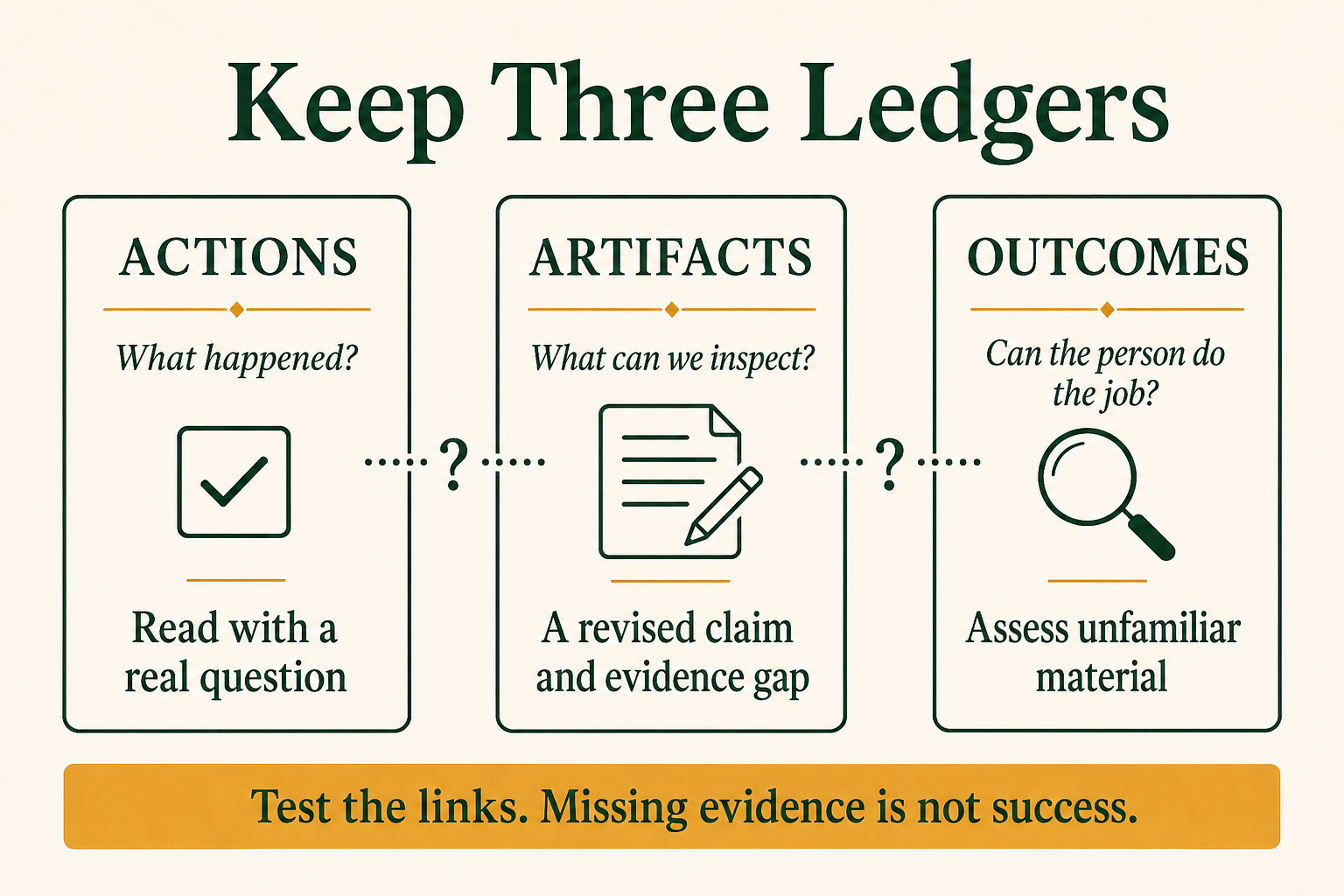
The first ledger records actions: what happened, when, and with what effort. The second records intermediate progress: an artifact, a correction, or feedback that makes the work inspectable. The third records the intended outcome in a situation close enough to the original job to be relevant. Calling all three “engagement” throws away the distinctions the team needs to learn.
In the hypothetical reading product, an action could be a short reading session organized around a real question. Its artifact might be a revised explanation with one supporting source and one counterexample. An outcome check might ask the reader to assess an unfamiliar passage a week later. That is still a limited assessment, not a comprehensive measure of research skill. It is nevertheless more closely connected to the stated job than counting minutes alone.
Feedback should help a person see what their effort produced. A revised claim, a newly identified uncertainty, or an explanation they can use in a meeting may be more informative than a larger score. Points are not inherently illegitimate. They become misleading when the product treats their growth as sufficient evidence that the customer’s goal is being met.
The ledgers also need distinct missing-data states. An outcome that has not reached its assessment window is pending. A check that the participant declines is unobserved. A completed check with a disappointing result is something else again. None of these should be silently converted into either success or failure. Arrows between action, feedback, and outcome represent relationships to test, not a guarantee that each step causes the next.
Lower friction without removing the work
There are two ways to make a task easier. Remove incidental effort, such as repeated setup or confusing navigation. Or remove the very work the product claims to support. Both can increase completion, but only the first preserves the original task by definition. The second requires a new argument about why the smaller action remains useful.
Duolingo’s historical account of separating its streak from its daily goal illustrates a trade-off. Completing one lesson could maintain the streak; the company reported better return metrics but fewer learners meeting their daily goals. This is a specific product experiment, not a universal finding that less effort produces more learning. It does not, on its own, establish improved real-world conversation. See [Duolingo’s account of the experiment](https://blog.duolingo.com/improving-the-streak/).
For the reading tool, a meaningful minimum might be to examine one relevant passage, state a judgment in the reader’s own words, and identify evidence that supports or challenges it. The task is short but has intellectual content. If the user is busy, reduce the scope of the passage or renegotiate the schedule. Do not quietly replace the judgment with an “I read this” button and continue reporting the same measure of progress.
A minimum is not necessarily permanent. Beginners need different support from experienced users, and unfamiliar material can make a previously easy task difficult. Offer levels or scaffolding while retaining a stable question: which part of the person’s intended capability did this action exercise? If the team cannot answer, it may be teaching customers to use the product rather than helping them with their work.
Let the real task set the clock
Daily return is convenient to chart. It is not a universal cadence for worthwhile activity. Weekly reviews, project research, and preparation for an upcoming interview can all involve repeat behavior without occurring every day. A person can also open an information feed daily while having no useful reason to perform a deep research exercise on each visit.
Strava offers a different organizing unit. Its official Training Log documentation describes an activity history that updates after an upload and can be inspected in weekly views. That is a product capability, not evidence of a health outcome or a causal retention effect. It shows how a progress interface can be organized around real activities and their history. See [Strava’s Training Log documentation](https://support.strava.com/en-us/articles/15402077-training-log).
Ask the customer when the next genuine opportunity will arise: the next meeting, the next piece of material, or the next practice session already on the calendar. A reminder can follow that opportunity. When the opportunity changes, let the schedule change too. A completed project should be allowed to end; sensible graduation and disappointed abandonment should not be collapsed into a single churn label.
This changes the denominator as well as the interface. If the measure is completion at the second agreed opportunity, report who has reached that opportunity, who has not, who paused, and who left. A task-based cadence is not permission to exclude inconvenient participants. Missing participants remain part of the account, with their status visible rather than explained away.
Make interruption a state, not a verdict
An identity such as “I am someone who takes research seriously” can help a user interpret small efforts as a continuing practice. Trouble begins when the software makes that identity hostage to an uninterrupted number. One missed event should not cause completed work to disappear or turn a scheduling problem into a character judgment.
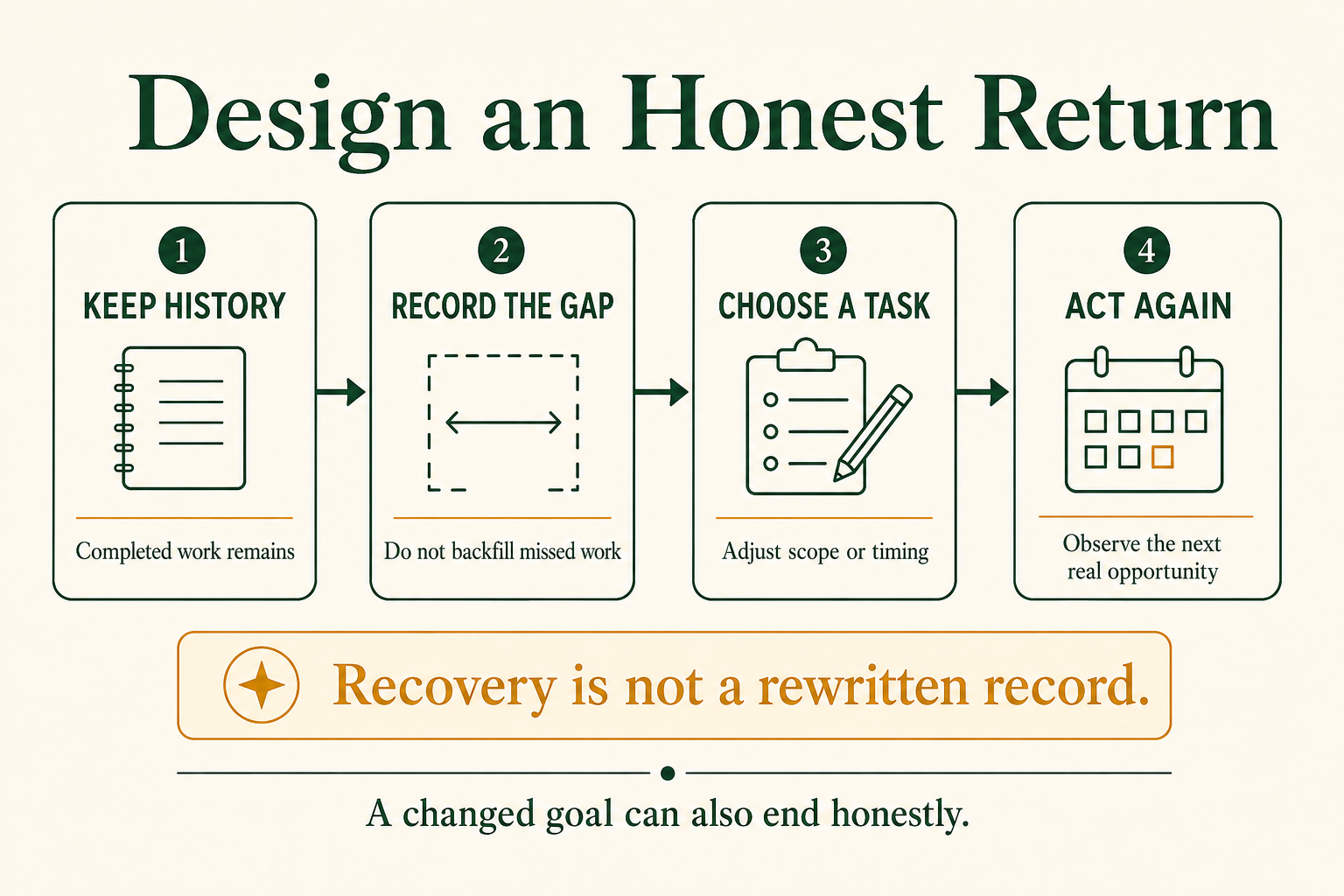
A recovery flow can preserve history while acknowledging the gap. Keep earlier notes. Do not backfill missed work as completed. Offer a smaller scope, a new opportunity, or an honest end to a goal that no longer matters. The user should not need to pretend that life has been uninterrupted in order to resume useful work.
Apple’s official guide describes pausing Activity rings without breaking an award streak. This establishes that pause and preserved history can coexist as explicit product states. It does not show that the design improves retention or health in every setting. See [Apple’s description of pausing Activity rings](https://support.apple.com/guide/watch/stay-fit-with-apple-watch-apd9c3cfe913/watchos).
For our hypothetical research tool, the return task could be to revisit one unresolved question rather than catch up on every missed article. Recovery is not complete merely because the app was opened. Look for a relevant action and then another action at the next agreed opportunity. If the underlying goal has changed, record the change. Preserving an obsolete commitment is not the same as preserving the user’s investment.
Check whether the counter is drifting away from the goal
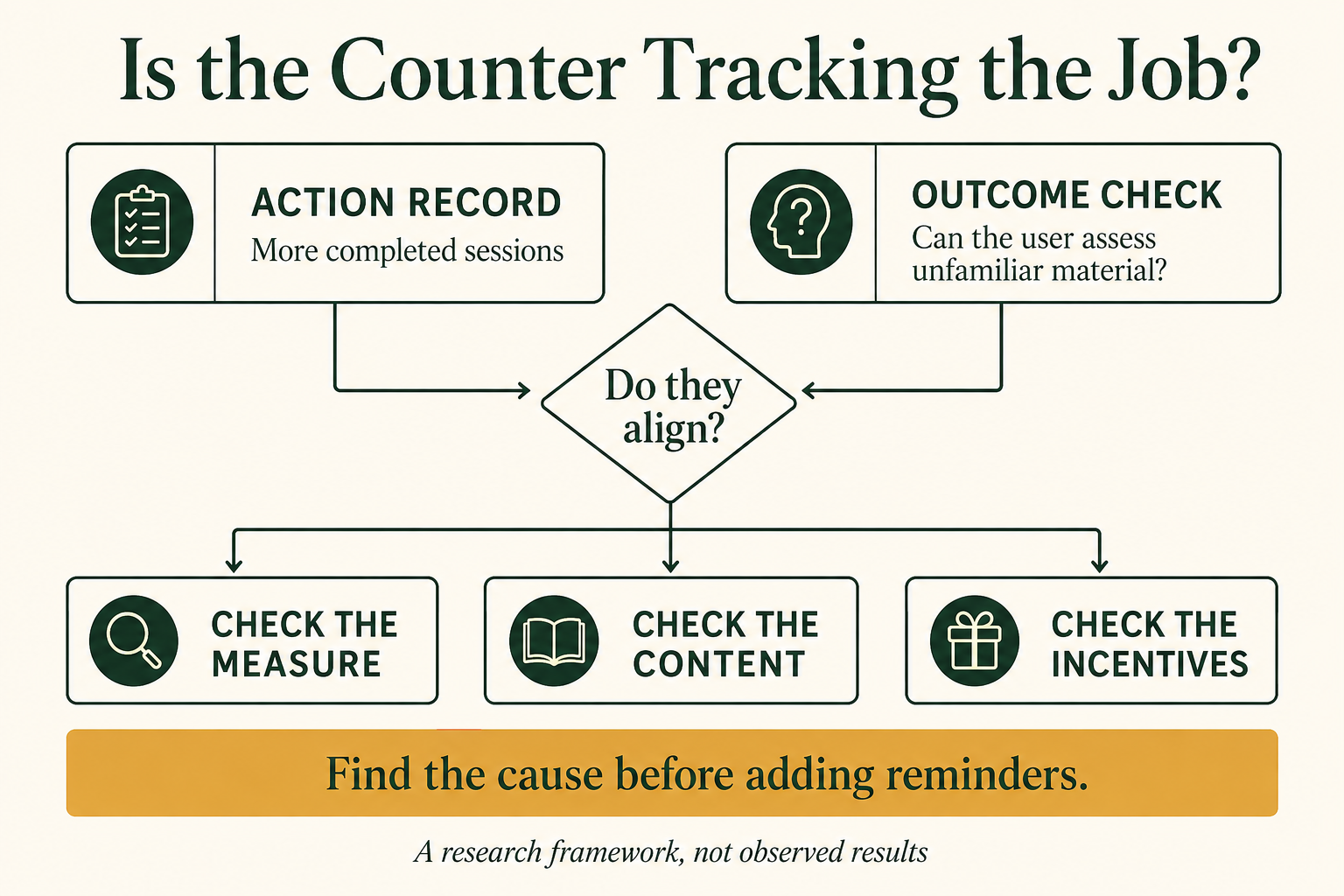
Imagine two readers with equally impressive calendars. One can identify evidence that contradicts a prior view. The other can only reproduce the explanation supplied by the app. This is a thought experiment, not a finding about actual users. Its purpose is to expose a testable question: does the completion rule require the capability the product promises, or can a participant satisfy it through low-effort repetition?
Use an unfamiliar piece of material with an agreed level of difficulty. Ask for the conclusion, the supporting evidence, a serious objection, and what remains unknown. Set the assessment criteria before looking at usage frequency. If practical, have a reviewer who does not know how often a participant used the product assess the work. Preserve examples and reasons for judgments so that a score does not become another opaque proxy.
The check has limits. Better performance on a repeated exercise may reflect familiarity rather than transfer. Writing style can obscure reasoning quality. A short window may be unsuitable for the promised change. Participants who agree to an assessment may differ from those who decline. Record these limitations rather than presenting the test as a complete view of capability.
Assessment itself can become friction. A person who bought a convenient history tool may not want a skills test. Ask at a sensible checkpoint, explain the purpose, and allow refusal. Refusal leaves the outcome unknown; it is neither proof of failure nor permission to claim success. If counters improve while the outcome does not, examine the measurement, content, task difficulty, and incentives before sending more urgent reminders.
Run a small test that can tell you something
An early-stage team does not need to impersonate a large experimentation organization. Start by walking a small number of willing participants through a complete task. Recruit for a specific recurring need, record the current workaround, and make sure each person understands the minimum action. This first exercise establishes whether the rule is usable. A small convenience sample is not a statistical demonstration of retention improvement.
Next, change one mechanism. Keep content, task difficulty, and reminder cadence stable while comparing a count-only display with a display of revised judgments and unresolved evidence gaps. If the sample and setting support random assignment, specify the assignment unit, observation window, primary measure, and stopping rules in advance. If you can only run sequential trials, say explicitly that familiarity, time, and participant selection complicate attribution. A before-and-after difference is not automatically an effect.
One candidate primary measure is meaningful action at the second natural opportunity. Report it alongside outcome checks, perceived burden, unusually low-quality completions, and exits. In a randomized test, keep the disposition of everyone assigned visible; do not analyze only the people who stayed. Speak with participants who interrupted their use, not just the most enthusiastic ones. An inconclusive result should stay inconclusive, with uncertainty and missing observations documented.
Recovery can then be tested without deliberately creating shame. Compare two acceptable return paths, such as choosing a new task immediately or first revisiting an unresolved question. Examine subsequent relevant work, not just the reopening event. Stop a design when it creates clear pressure, misleading records, or privacy problems. A commercial metric does not excuse continuing a harmful interaction.
Separate the learning case from the buying case
A product can support a useful practice and still fail to make economic sense. A customer may have an adequate free alternative, need only short-term support, or value the archive without valuing the premium service. Repeat action, goal attainment, and renewal are separate claims. Drawing them in a funnel does not establish the conversion between them.
Explain what an additional payment purchases: more reliable feedback, support for harder tasks, a history that is easier to reuse, or reduced organizational effort. If renewal depends mainly on fear of losing a record, the payment signal becomes difficult to interpret as freely chosen value. Clear cancellation and access to personal history help the team understand what customers actually want to keep buying.
Delivery cost matters too. If the founder personally reviews every exercise, customer appreciation does not show that the price covers the service. Track review, communication, and revision time before imagining automation. Future model capabilities are not current margins. Replacing thoughtful feedback with generic encouragement to lower cost may also remove the very benefit that made the offer useful.
The same evidence discipline rules out casual winner-and-failure rankings across learning, exercise, and meditation products. Public scale, feature availability, clinical outcomes, and subscriber retention answer different questions. This article carries forward no unverified market-size figures or health claims. Lack of public retention data is an information gap, not a verdict that a business has lost its market.
Write a review that your next observation can overturn
Begin the weekly product review with the real task, its cadence, and the completion rule. Put action records, intermediate artifacts, outcome checks, and missing information next to one another. Then list competing explanations. Did the task become easier? Did the reminder arrive at a better moment? Were these participants already unusually motivated? Did the feedback actually help them act again?
Each explanation should point to evidence to collect, not automatically to a feature to build. Interview interrupted users when you do not understand the gap. Inspect artifacts when you do not understand quality. Revisit an actual offer and its alternatives when you do not understand nonpayment. Product research should progressively reduce uncertainty, not merely increase the number of mechanisms surrounding the customer.
The central question is simple: at the next real opportunity, can the person more easily do something that matters to them, and can you inspect the basis for that claim? Habit supports repetition. Identity can preserve continuity. An outcome check keeps the product honest about what the repetition achieved. The asset worth building is not a number that must never break. It is a history that remains truthful, useful, and resumable when life does.
First-party feature descriptions were checked on September 7, 2026. The historical product experiment is not evidence of current performance. This article is a product research framework, not a guarantee of educational, medical, or exercise outcomes.
Start with a recent customer job and specify a meaningful minimum, a natural cadence, an outcome check, and an honest recovery path.
This is an unvalidated product research framework. The reading product and experiments are hypothetical; no customer outcomes, market rankings, health effects, or universal retention gains are asserted.