
What judgment does this research establish, and what evidence would invalidate it?
Reframing the problem: from a large bill to a traceable value leak
AI cost discussions often begin with a simple question: how many tokens did we use, and how much did they cost? For a product team, however, the total is only the starting point. The harder questions are: which customers, workflows, teams, or projects generated the cost? Did that cost support revenue or a measurable product outcome? Which portion reflects necessary service delivery, and which portion comes from repeated prompts, oversized context, expensive default models, retry storms, idle capacity, or abusive usage?
This article examines AI Model / API Spend Optimization as a research problem. It separates cost visibility, cost attribution, optimization actions, and customer-level gross-margin control. It also separates public facts, vendor-selected customer evidence, inference, hypotheses, and unknowns.
The central conclusion is deliberately narrow. A cost tool creates potentially valuable information when it connects request-level usage, provider records, customer or workflow boundaries, revenue data, and outcome guardrails, then supports an action that can be checked and reversed. Public materials support the existence of several reporting, estimation, attribution, budget, and alerting capabilities. They do not prove that customers have achieved savings, improved gross margin, increased retention, or demonstrated willingness to pay more.
A money flow is not the same as a cost report
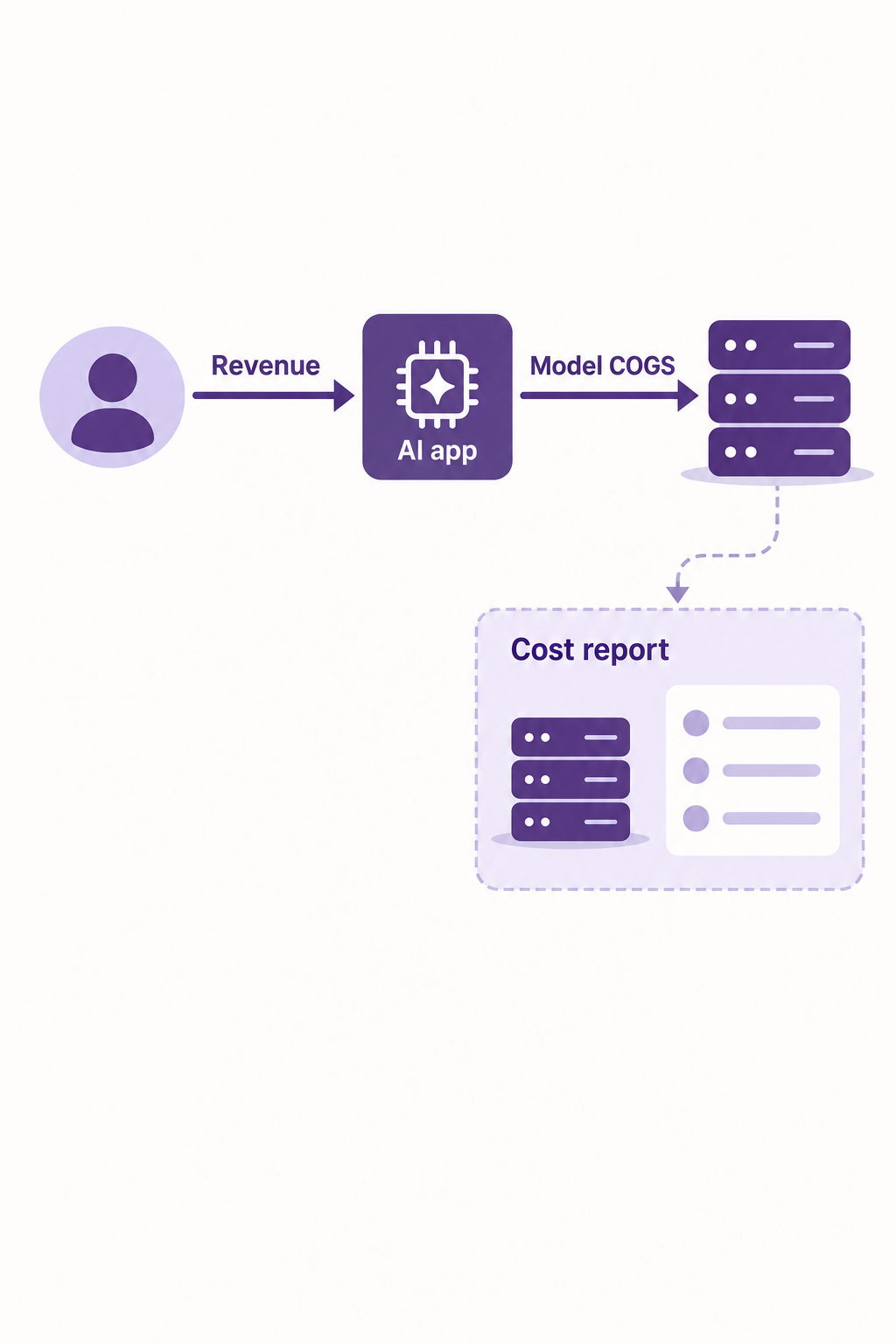
The basic flow is: end-customer subscription or transaction revenue → AI application → model and inference COGS → model and infrastructure providers. An optimization product sits in the middle of this flow. It can capture value only if it reduces COGS or prevents margin leakage without degrading product quality, latency, safety, or reliability.
That condition matters. A provider report can tell an operator how many requests or tokens occurred and may provide a cost estimate. Gross-margin control additionally requires knowing whom those requests served, which revenue boundary they belong to, whether the service generated the promised outcome, and whether the optimization created a new cost elsewhere.
A budget limit may prevent spending without increasing profit. A cheaper model may reduce per-request cost while increasing review work, retries, support burden, or customer churn. A lower displayed estimate may reflect a changed provider price rather than a real operational improvement. Therefore, “cost reduction” is an intermediate metric, not a complete business result.
A stronger verification chain asks: Can the cost be traced? Is attribution sufficiently complete? Can revenue and customer boundaries be defined? Is the intervention reversible? Are quality, latency, security, and reliability measured before and after? Does the result improve customer-level economics rather than merely move cost into labor, infrastructure, or failure handling?
Four capability layers that should not be collapsed
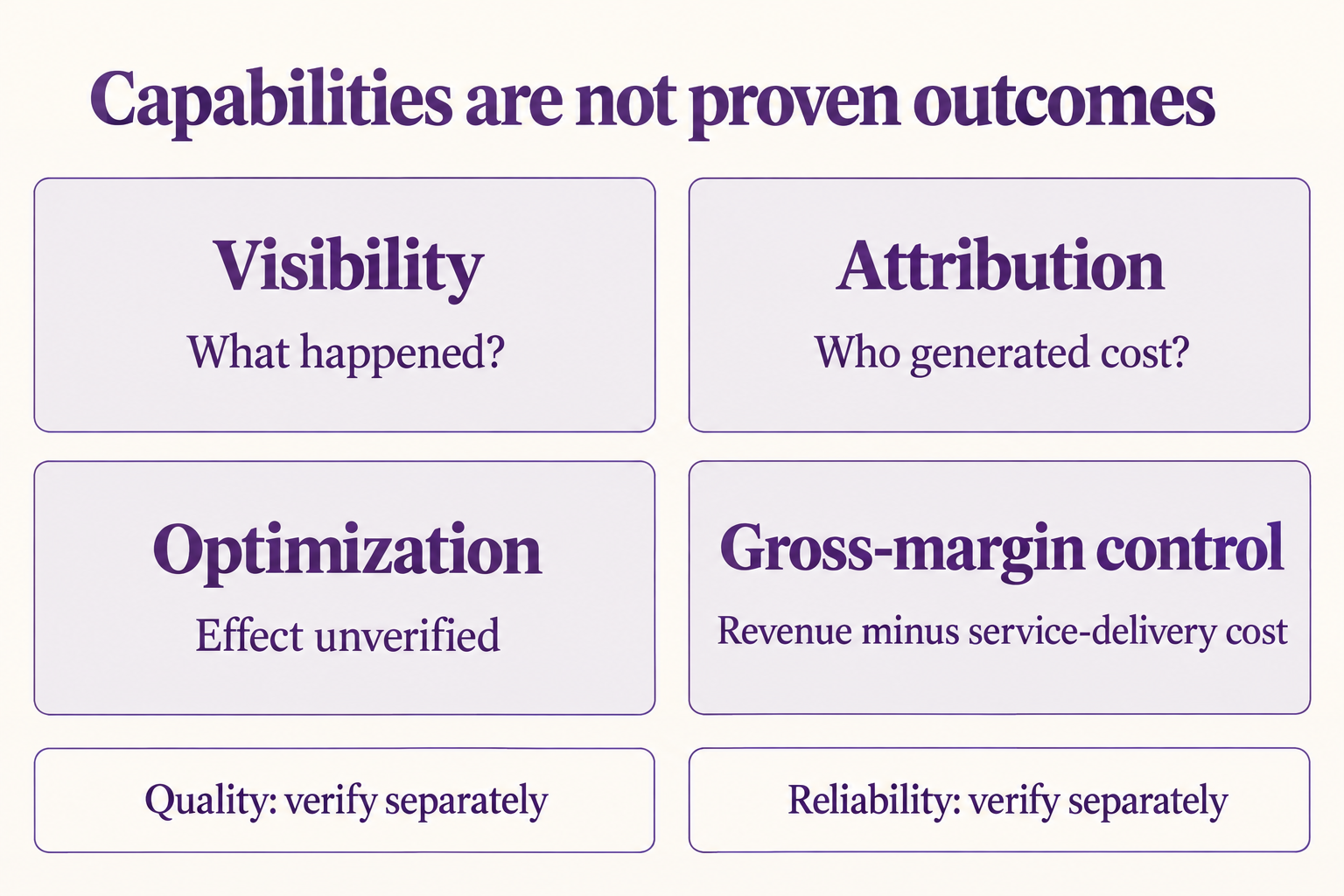
The first layer is cost visibility. It answers what happened: requests, input and output tokens, model, time, workspace, project, and a billed or estimated amount. Anthropic’s public documentation distinguishes organization-level usage reports from cost reports. Usage reports can be filtered and grouped by dimensions such as API key, workspace, and model. Cost reports group by workspace or description and may include parsed model information. This supports a reporting capability, but it does not mean every usage dimension is also a cost-grouping dimension. It also does not turn an organization-level report into a customer-profit report for a non-organization account.
The second layer is cost attribution. It answers who or what generated the cost: a customer, user, workflow, team, project, feature, or request tag. Vercel documentation describes Custom Reporting with tags, user IDs, and quota entity IDs attached to requests. The same material describes budgets for teams, projects, API keys, or team members. These are different concepts. A user ID that can be queried is not automatically a customer-level budget object, and neither proves that revenue or margin has improved.
The third layer is an optimization action. It answers what can change: model routing, caching, context reduction, retry policy, limits, prompts, or workflow design. The action must be paired with outcome guardrails. Otherwise, a system can classify “cheaper” as “better” even when quality falls, latency rises, contractual data handling becomes unsafe, or error rates increase.
The fourth layer is customer-level gross-margin control. It asks what the cost means economically: after deducting the attributable cost of delivering the service from a customer’s revenue, does the account still meet a gross-margin target while service commitments remain intact? This cost boundary covers delivery-related model usage, infrastructure, delivery labor, and other cost of sales. Selling, administrative, and product-development expenses require a separate profitability analysis; they should not all be folded into gross-margin costs. Public materials support components of the earlier layers. They do not establish that a particular tool has completed this entire loop.
What the public cases support—and what they do not
Cloudflare publicly describes monitoring, comparing, customizing prices, and estimating token costs across AI providers. This supports a useful mechanism claim: multi-provider costs can be normalized for observation rather than kept inside one provider dashboard. But Cloudflare also warns that cost metrics are estimates and provider prices may change. An estimate can support directional monitoring; it cannot be treated as an invoice reconciliation or realized savings.
Vercel’s material places request attribution and budget controls in the same product context, but they are not interchangeable. A tag can improve queryability without covering every request. A team or project budget can limit spend without revealing a customer’s revenue or gross margin. Attribution completeness, data latency, cross-provider normalization, and treatment of anomalous requests all affect whether this capability can support an operating decision.
Helicone’s Wordware case reports that, as the customer scaled, it needed to answer which workflows generated costs and had manually downloaded CSV files and written JSON scripts. This is vendor-selected evidence from a single customer. It supports the claim that workflow-level cost visibility can be a real operational problem. It does not establish independent validation, savings magnitude, retention, willingness to pay, or representativeness.
Vantage described connecting LLM observability records to corresponding cost rows and allocating them by team, user, application, or custom metadata, with reports, labels, and alerts. The announcement described the capability as a private preview at that time. A historical preview cannot be treated as a currently universal capability. It illustrates a product mechanism, not current availability, independent customer outcomes, or commercial validation.
Supporting evidence and counterevidence belong together
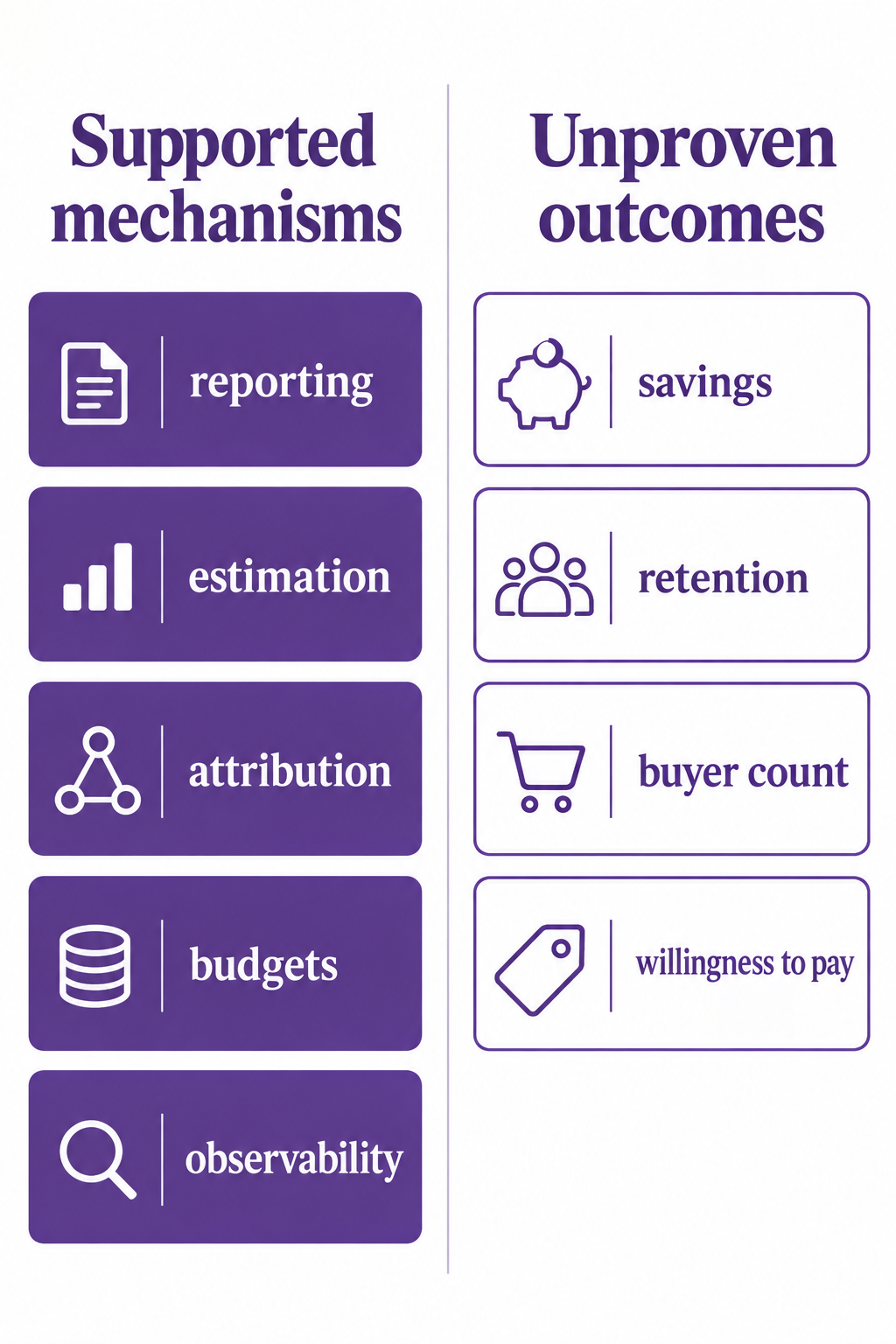
The supporting evidence shows that the mechanism exists in pieces: organization-level usage and cost APIs, cross-provider cost estimation, request tags and user attribution, budget controls, reporting and alerts, and one vendor-selected customer observation case. Together, these materials make it plausible that teams can move from a token bill toward object-level cost management.
The counterevidence is equally important. Costs may be estimates rather than invoice-reconciled amounts. Usage groups, cost groups, attribution identifiers, and budget objects may come from different data models. A vendor-selected customer story lacks an independent sample, a counterfactual, and longitudinal evidence. Lower-cost routing or aggressive caching can damage quality, latency, security, or reliability. The available materials do not establish cross-customer savings, revenue impact, retention, buyer counts, adoption, or incremental willingness to pay.
One negative unknown should also remain visible: there is not enough evidence to isolate a company shutdown, retention failure, or operating improvement caused by LLM cost optimization itself. The absence of a sourced failure case does not prove that failure risk is absent. But inventing a failure story to make the argument symmetrical would be equally wrong. The correct status is that the evidence is insufficient.
A testable value-creation mechanism
A narrower and more testable product claim is this: connect request-level usage with customer, workflow, team, or project metadata, then support attribution and action under budget, quality, latency, security, and reliability constraints. This is more precise than saying “we help you save AI costs” because it specifies the data inputs, decision objects, and guardrails.
Four questions should drive validation. First, can the data cover real requests and reconcile to provider records and internal accounting? Second, can customer and revenue boundaries be defined consistently rather than through temporary manual mappings? Third, can an intervention be compared before and after while measuring cost, quality, latency, security, and reliability? Fourth, does the saving improve customer-level gross margin on a consistent service-delivery cost basis? Period expenses and customer churn also need separate scrutiny as business consequences, not automatic classification as cost of sales.
These are validation requirements, not claimed business outcomes. Without a real customer baseline, a comparison, or longitudinal records, a reliable savings rate cannot be calculated and prediction calibration cannot be performed. Without transaction, retention, or payment evidence, one cannot claim that customers paid, renewed, or achieved an outcome.
When the mechanism can transfer—and when it cannot
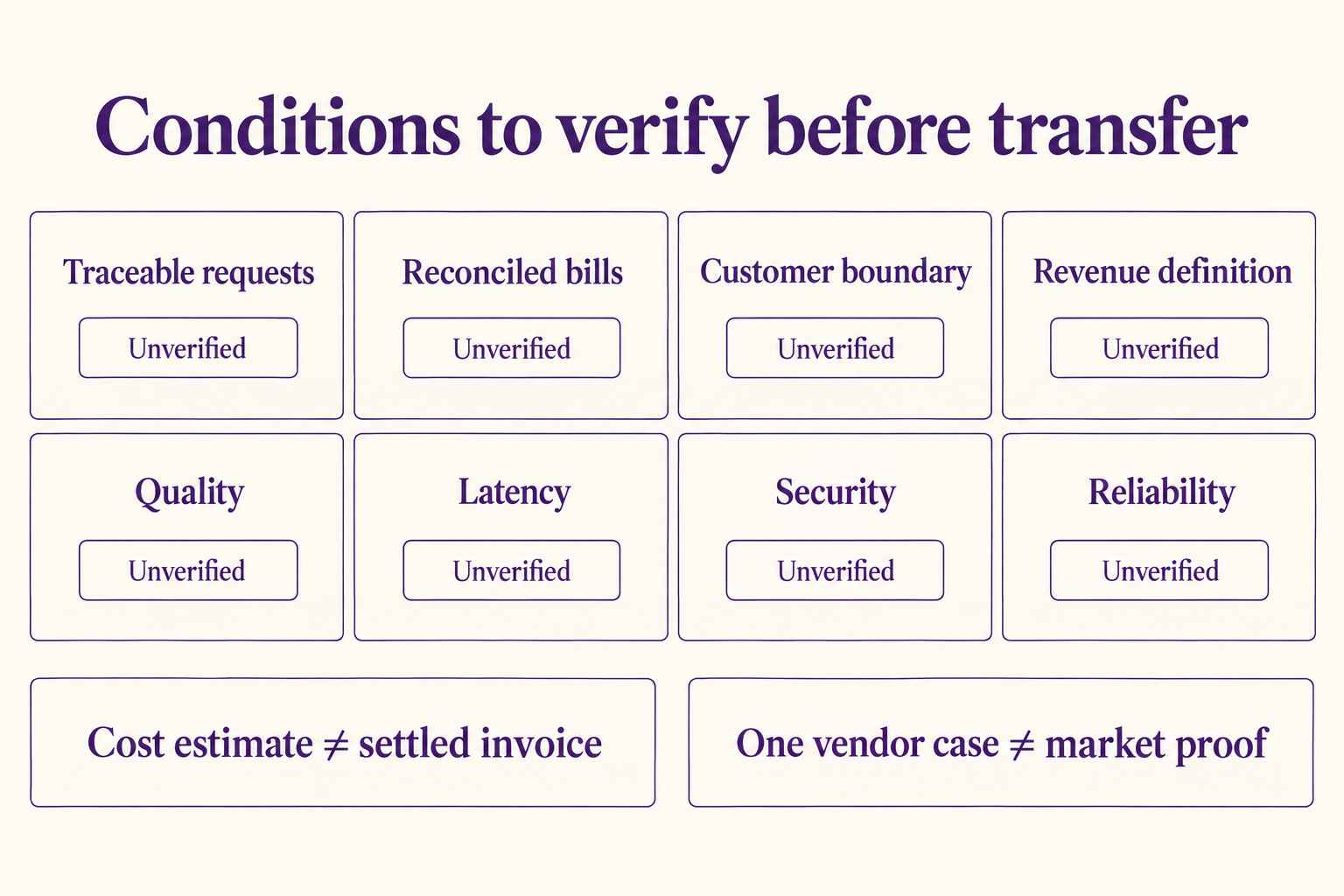
Transfer conditions include accessible and traceable request or workflow data; reconciliation between provider bills and internal records; definable customer, project, and revenue boundaries; sufficiently complete attribution; interventions that can be limited, reversed, and monitored; explicit quality, latency, security, and reliability guardrails; and a repeatable process that does not require large bespoke mappings for every customer.
The non-transfer conditions are just as important. Anthropic’s organization-level capabilities cannot be treated as proof of customer-level margin for non-organization accounts. Cloudflare’s estimated costs cannot be treated as invoices. Vercel’s attribution tags cannot be treated as automatic customer budgets. A single Wordware case cannot be treated as a representative market sample. A historical Vantage private preview cannot be treated as generally available today. Lower prices, caching, routing, or a lower cost number cannot be rewritten as revenue, retention, or profit outcomes.
Implementation cost is another boundary. If integration, cleaning, mapping, and maintenance cost more than the avoidable waste, the control product becomes a new fixed cost. If the customer lacks a stable revenue boundary, customer-level gross margin remains an estimate. If the product cannot measure quality and service outcomes, it may simply produce misleading savings numbers faster.
The buyer problem and the next validation step
Potential buyers may include product leaders, engineering leaders, or FinOps teams responsible for AI COGS. A person with a problem is not automatically a paying buyer. The useful questions are: Who carries the unexplained cost? Which workflows require customer or project attribution? Do finance, engineering, and product use the same cost definition? What contractual or quality risk would a wrong optimization create? Which decision layer is missing from the existing provider reports?
The next step should be a baseline, not a promise. Record requests, tokens, models, cost definitions, customer or workflow tags, revenue boundaries, quality metrics, latency, error rates, and human intervention over a defined period. Select one reversible intervention. Define success and failure in advance. Compare the full cost and product outcome before and after.
If the only record is a total bill, the source of savings cannot be known. If the only metric is the share of low-cost model calls, it is impossible to know whether the user experience deteriorated. The major commercial unknowns remain the target ICP’s waste and savings rate, access to customer revenue and COGS data, attribution completeness, guardrail performance, implementation cost, cross-customer effects, retention, buyer counts, and incremental willingness to pay.
Conclusion: reconcile first, claim margin control later
The path from a token bill to customer-level gross-margin control contains at least four gates: see the cost, attribute it correctly, take a reversible optimization action, and demonstrate an economic result at the customer level. Public materials show several relevant capabilities, but capability existence is not commercial impact. A single case is not PMF. An estimated decrease is not realized margin improvement.
The most defensible research judgment is therefore: cost visibility and object-level attribution are observable product mechanisms; optimization actions are risk-bearing inferences; customer-level gross-margin control remains a hypothesis requiring revenue, cost, quality, and longitudinal evidence together. The important research question is not which dashboard has the most features. It is whether a system can reconcile real data boundaries and make its intervention auditable without sacrificing quality, latency, security, or reliability.
The available evidence does not prove independent customer savings, cross-customer effects, retention, buyer counts, adoption, incremental willingness to pay, or market size. It also does not provide sufficient contemporaneous records made before the events for prediction calibration. Preserving those unknowns is what prevents vendor features, inferences, and hypotheses from being mislabeled as business facts.
Further reading: Anthropic Usage and Cost API (https://platform.claude.com/docs/en/manage-claude/usage-cost-api); Cloudflare AI Gateway Costs (https://developers.cloudflare.com/ai-gateway/observability/costs/); Vercel AI Gateway Pricing (https://vercel.com/docs/ai-gateway/pricing); Helicone × Wordware case (https://www.helicone.ai/customers/wordware); Vantage LLM Token Allocation announcement (https://www.vantage.sh/blog/llm-token-allocation-preview).
Write down one real workflow’s request data, provider cost record, customer or project boundary, revenue definition, quality guardrail, and before/after comparison before making a savings claim.
This article relies on public provider documentation, a vendor-selected customer case, and mechanism analysis. Anthropic describes organization-level usage and cost reporting; Cloudflare states that cost metrics may be estimates; Vercel’s attribution identifiers and budget objects are not automatically equivalent; the Wordware material is a single vendor-published case; and the Vantage announcement described a private preview whose current availability is unknown. The evidence does not independently establish customer savings, gross-margin improvement, quality outcomes, retention, buyer counts, adoption, incremental willingness to pay, market size, or prediction calibration.